

News

23
Aug
How to Launch a Diode Laser Hair Removal Machine in a New Market: A Practical Guide for Distributors
Launching a diode laser hair removal machine in a new market is not as simple as finding a machine with the right price and placing an order. Many distributors and clinic owners discover too late that poor supplier support, unclear regulations, weak training, or the wrong machine configuration can quickly turn a promising investment into a costly problem. This practical guide shows you how to choose the right diode laser, build a workable launch strategy, and create a business model that helps your customers—and your own business—make money.
Why Launching a Diode Laser Business Is More Than Choosing a Machine
A new market can look attractive on paper, but the machine itself is only one piece of the business. Before you order a professional diode laser hair removal machine, you need to think about who will buy it, how they will use it, how they will promote treatments, and what happens when they need technical support.
A good machine does not automatically mean a good business
A machine can have impressive specifications and still be difficult to sell if it does not match the local market. The real question is not “How powerful is this diode laser?” but “Can my customers use it confidently, attract clients, deliver treatments efficiently, and make a reasonable return on their investment?”
The three biggest risks distributors face in a new market
The most common problems are buying from a supplier that cannot provide reliable after-sales support, choosing a configuration that does not match local demand, and selling the machine without giving customers enough training. These issues often appear after the sale, which is exactly why they should be considered before the first order.
What successful distributors do differently
Strong distributors do not simply import a diode laser machine and wait for customers; they build a complete offer around the equipment. That usually includes product positioning, training, treatment guidance, marketing materials, technical support, spare parts, and a clear reason for the customer to choose their machine over a cheaper competitor.
A simple way to think about the business:
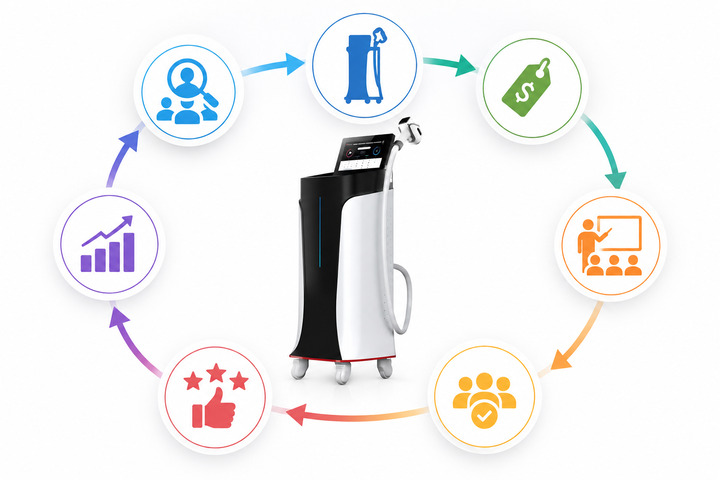
Market demand → Right machine → Competitive offer → Training → First customers → Local proof → Repeat sales → Market growth
Step 1 — Understand Your Local Market Before Choosing a Diode Laser
Before comparing manufacturers or asking for quotations, spend time understanding the market you want to enter. A little research at the beginning can save you from buying machines that are technically good but commercially difficult to sell.
Who are you actually selling to?
Your ideal customer could be a beauty salon looking to add hair removal, an aesthetic clinic wanting to expand its treatment menu, a doctor building a new practice, or another distributor looking for a reliable product line. Each customer has different priorities, so your diode laser hair removal machine should be positioned around the customer rather than around the factory's product catalog.
| Customer Type | Main Concern | What They Usually Need |
|---|---|---|
| Beauty Salon | Treatment speed and ROI | Easy operation, comfortable treatment, marketing support |
| Aesthetic Clinic | Performance and reliability | Professional configuration, training, technical support |
| Doctor / Practitioner | Safety and documentation | Appropriate certification, protocols, reliable supplier |
| Distributor | Margin and scalability | Factory pricing, OEM, sales tools, after-sales support |
| Clinic Chain | Consistency | Standardized equipment, training, service support |
What does your market already have?
Look at the diode laser machines already being sold locally and record their price, wavelength configuration, spot size, cooling system, warranty, training, and marketing claims. More importantly, talk to actual clinic owners and ask what they like and dislike about their current machines—those answers often reveal more than a competitor's brochure.
Find the gap instead of copying the cheapest competitor
If every supplier in your market is competing around the lowest price, joining the same price war is rarely a good long-term strategy. You may have a stronger opportunity by positioning your professional diode laser around faster workflow, better cooling, easier operation, stronger training, OEM branding, dependable support, or a better overall ownership experience.
A simple market research checklist before placing your first order
Before making a purchase, confirm the treatment prices in your market, the major competitors, customer expectations, local regulations, import requirements, available service resources, and the type of customer you want to target. You should also estimate how many potential clinics you can realistically reach rather than assuming that a large population automatically means a large market.
| Question | What to Find Out | Why It Matters |
|---|---|---|
| Who buys? | Salons, clinics, doctors, distributors | Determines product positioning |
| What do they use? | Diode, IPL, other hair removal technologies | Shows competitive pressure |
| What do they pay? | Machine and treatment prices | Helps build pricing |
| What do they complain about? | Cooling, speed, downtime, service | Reveals market opportunities |
| What documents are required? | Local regulatory requirements | Reduces compliance risk |
| Who can operate it? | Local professional requirements | Affects customer targeting |
| What support is missing? | Training, service, spare parts | Helps differentiate your offer |
Step 2 — Choose the Right Diode Laser Hair Removal Machine for Your Market
Once you understand the market, you can start selecting the machine. This is where many buyers make the mistake of comparing only price and wattage instead of looking at the complete treatment system.
Do you really need a multi-wavelength diode laser?
Not every market needs the most complicated configuration, and not every customer needs every wavelength. A multi-wavelength diode laser can give distributors more flexibility when serving different skin and hair types, but the better choice is the configuration that fits your actual customer base and treatment strategy.
755nm vs 808nm vs 1064nm: What Actually Matters for Your Market
Different wavelengths have different characteristics, so wavelength selection should be based on the skin and hair profiles you expect to treat. In many professional diode laser hair removal systems, 808nm is widely used as a core wavelength, while 755nm and 1064nm can add flexibility for different treatment needs; however, wavelength count alone does not determine treatment quality.
| Wavelength | Common Positioning | Key Consideration |
|---|---|---|
| 755nm | Fine or lighter hair applications | Often selected for its absorption characteristics |
| 808nm | General-purpose hair removal | Widely used as a core diode laser wavelength |
| 1064nm | Deeper penetration / darker skin applications | Useful when treating a broader range of skin types |
| Multi-wavelength | Broader treatment flexibility | More options, but usually higher equipment complexity |
How to evaluate laser power without being fooled by the number on the brochure
A large wattage number does not automatically mean faster or better hair removal. Look at the relationship between fluence, pulse width, repetition rate, spot size, cooling performance, treatment technique, and actual laser output, and ask the manufacturer how the specifications are measured instead of comparing one headline number with another.
Cooling matters more than many distributors realize
Effective cooling is directly connected to treatment comfort and the operator's ability to work efficiently. When evaluating a diode laser hair removal machine, ask about the cooling method, temperature control, water circulation, handpiece cooling, and how the system is tested under continuous operation rather than simply accepting “strong cooling” as a marketing claim.
Choose the machine around the treatment workflow, not the specification sheet
A clinic uses the handpiece, screen, cooling system, water system, and software every day—not the specification sheet. A lighter handpiece, practical spot size, stable cooling, intuitive controls, and easy maintenance can make a bigger difference to a busy clinic than another impressive number on the brochure.
What to evaluate before buying:
Laser Configuration
        ↓
Output & Treatment Parameters
        ↓
Spot Size + Pulse Control
        ↓
Cooling Performance
        ↓
Operator Workflow
        ↓
Maintenance & Reliability
        ↓
Customer ROI
Step 3 — Make Sure the Machine Can Legally Enter and Operate in Your Market
A machine can be technically excellent and still be the wrong product for a particular country if its documentation or regulatory pathway does not fit the local requirements. Always check the rules for your destination market before placing the order.
Certification is not the same as market approval
Having a CE marking or other conformity documentation does not automatically mean a device can be marketed or operated without additional requirements in every country. The exact obligations depend on the destination market, product classification, intended use, and local authority requirements, so distributors should verify the applicable rules rather than relying only on a supplier's certification list.
What should you ask a diode laser manufacturer for?
Ask for the documents that are relevant to your target market, such as conformity documentation, electrical safety information, user manuals, labeling information, test reports, and technical documents where applicable. A reliable manufacturer should be able to clearly explain which documents they can provide and which registration or import responsibilities remain with the local distributor.
Check local regulations before you pay the deposit
Do not wait until the machine is already in production to investigate regulatory requirements. Confirm whether registration, importer requirements, professional-use restrictions, local language labeling, or other approvals apply to your specific market and intended use.
A practical supplier question: “Can you support my market?”
Instead of simply asking, “Do you have CE?”, ask the manufacturer to explain what documentation they can provide for your country and what similar markets they have already supported. A supplier who understands international distribution should be comfortable discussing documentation, shipping, installation, training, and after-sales support—not just the machine price.
Step 4 — Choose a Diode Laser Manufacturer, Not Just a Cheap Supplier
Your supplier becomes part of your business whether you like it or not. If your customer has a problem, they will not care whether the issue came from the factory, shipping company, or distributor—they will contact you.
How to tell whether you are dealing with a real factory or a trading company
Ask where the machine is actually manufactured, whether you can see the production facility, how quality control is handled, and who performs final testing. A genuine factory should be able to explain its manufacturing process clearly rather than only sending a polished product catalog.
Ask to see the production and quality-control process
Good quality control should cover more than checking whether the machine turns on before shipment. For a diode laser machine, you should ask about component inspection, assembly checks, laser output testing, cooling-system testing, aging or burn-in tests where applicable, final inspection, and packaging checks.
| Quality-Control Stage | What a Distributor Should Ask |
|---|---|
| Components | Are incoming parts inspected? |
| Assembly | Is each machine individually tested? |
| Laser system | How is output performance checked? |
| Cooling | Is continuous cooling performance tested? |
| Electrical | What safety checks are performed? |
| Aging test | Is the machine tested before shipment? |
| Final inspection | Is there a documented QC checklist? |
| Packaging | How is the machine protected during transport? |
Ask what happens when your customer's machine has a problem
Before ordering, ask how troubleshooting works, who provides technical support, how spare parts are supplied, what the warranty covers, and how quickly the factory normally responds. A supplier that disappears after receiving payment is not a low-cost supplier—it is a high-risk supplier.
The five supplier questions I would ask before placing the first order
Ask the manufacturer: What is tested before shipment? Which components can be replaced locally? How quickly can spare parts be supplied? What training is included? Who supports my customer after the sale? The answers will tell you much more about the supplier's real value than another $100 discount.
Step 5 — Build a Pricing Strategy That Leaves Room for Everyone to Make Money
The purchase price is only the beginning of your cost calculation. A healthy diode laser business needs enough margin for the distributor, enough value for the clinic, and enough room to provide service after the sale.
Do not calculate your margin from the machine price alone
Your real cost can include shipping, import taxes, local handling, installation, training, marketing, spare parts, payment fees, and warranty costs. If you ignore these costs, the margin you see on paper may disappear quickly after the first few customers.
Calculate the real landed cost
Build a simple landed-cost model before you set your selling price. This gives you a much clearer picture of what the machine actually costs when it reaches your warehouse or customer's clinic.
| Cost Item | Example to Include |
|---|---|
| Machine | Factory purchase price |
| Shipping | Air, sea, or other transport |
| Import | Duties, taxes, customs |
| Local Costs | Handling, storage, delivery |
| Installation | On-site or remote setup |
| Training | Staff training and materials |
| Marketing | Demo, content, advertising |
| Warranty | Spare parts and service reserve |
| Sales | Commission and customer acquisition |
Leave enough margin for your downstream customers
If you are selling to another distributor, that distributor also needs enough margin to sell to clinics. If the final clinic cannot make money after paying for the machine, your low factory price will not solve the problem.
Why the cheapest diode laser machine can become the most expensive one
A cheaper machine can become expensive when it has frequent downtime, weak cooling, difficult-to-source parts, poor documentation, or no technical support. For a professional clinic, lost treatment appointments and unhappy customers can cost far more than the initial difference in machine price.
Build your price around value, not only specifications
Instead of saying, “Our machine is $X cheaper,” explain what the customer receives for the total investment: equipment, training, warranty, technical support, marketing resources, and long-term service. This creates a stronger sales argument and helps you avoid competing against every low-cost supplier in the market.
Step 6 — Decide Whether You Should Sell a Manufacturer Brand or Build Your Own
There is no single right answer for every distributor. If you are testing a new market, an established manufacturer brand may be easier to start with, while OEM can become more attractive once you understand your customers and sales channel.
When selling an existing brand makes more sense
An existing brand can be a practical choice when you are entering a market for the first time and want to focus on sales rather than building every part of the brand yourself. It can also reduce the initial workload around product materials, training, and technical documentation.
When OEM / private label becomes a better strategy
OEM becomes more interesting when you already have a customer base, want stronger control over your market positioning, or plan to build a long-term product line. Instead of selling the same machine under the same appearance as many competitors, you can develop a clearer identity around your own brand.
What can actually be customized on an OEM diode laser?
Depending on the manufacturer's capabilities and order requirements, customization may include the logo, housing appearance, software interface, language, packaging, labels, and marketing materials. The key is to customize what improves your market positioning rather than changing things simply because customization is available.
Do not customize everything on your first order
If you have never tested the market, ordering a large quantity of heavily customized machines creates unnecessary risk. A smarter approach may be to validate demand first, then gradually move from simple branding to deeper OEM or ODM development as sales become more predictable.
Step 7 — Prepare Your Sales Team Before the Machine Arrives
A distributor can lose a good product simply because the sales team does not know how to explain it. Your team needs enough technical knowledge to build trust, but it also needs to understand the customer's business.
Product knowledge is not enough
Your salesperson does not need to become a laser engineer, but they should understand the key specifications, treatment workflow, suitable customer profiles, basic safety considerations, and common questions. Most importantly, they should know how to connect machine features with practical business benefits.
Your sales team should be able to answer these customer questions
Customers will ask whether the machine is suitable for their target skin types, how comfortable treatments are, how fast a session can be, what training is included, what happens if something goes wrong, and what the ongoing maintenance requirements are. If your salesperson cannot answer these questions, the customer may simply choose the supplier who explains them better.
Build a simple sales toolkit
Give your team more than a PDF brochure. A useful toolkit can include a specification sheet, treatment guidance, FAQ document, product comparison sheet, training videos, customer case studies, marketing images, and a simple ROI calculator.
Train your team to sell the business outcome, not just the machine
Instead of saying, “This machine has three wavelengths and a large screen,” teach your sales team to explain how the configuration can support the customer's treatment menu, workflow, target market, and revenue model. Customers buy equipment because they want a better business outcome—not because they want another machine in the treatment room.
Step 8 — Launch With a Demo Strategy, Not Just a Product Announcement
A new product needs proof, especially when customers have never heard of your brand. Your first few machines should be treated as market-building tools, not simply sales orders.
Why your first 3–5 customers matter more than your first 50 leads
Your first customers can give you local testimonials, treatment feedback, photographs, videos, objections, and real-world data. A distributor with five strong local cases can often sell more effectively than one with hundreds of generic product images.
Find your early adopters
Look for clinics and salons that already understand professional hair removal and are willing to test a new solution. Existing customers who already trust your company can be especially valuable because they require less education about your service and support.
Turn the first machines into local proof
With appropriate customer consent and according to local advertising rules, document treatment experiences, operator feedback, machine demonstrations, and business results. Local-language case studies usually feel much more credible to prospects than generic factory photos.
Create a launch offer that protects your long-term pricing
Avoid making a huge discount the main reason people buy your new diode laser machine. A better launch package could include operator training, marketing materials, installation support, an extended support package, or other value-added services that help the customer get started successfully.
Step 9 — Help Your Customers Make Money With the Machine
This is where a supplier can become much more valuable than a typical equipment seller. If you can help a clinic turn the machine into a profitable treatment service, you become a business partner rather than simply another vendor.
Start with the customer's business model
Before recommending a machine, ask how the clinic currently charges for treatments, which body areas are most popular, how many clients it sees each month, and whether it wants premium positioning or high-volume treatments. The right equipment configuration should support that business model.
Build treatment packages instead of selling single sessions
Many clinics can create more predictable revenue by offering treatment packages, area-based plans, memberships, or seasonal promotions rather than relying only on individual sessions. The exact pricing should be based on local market conditions, but the basic idea is simple: turn a one-time treatment into a structured customer journey.
Help clinics calculate their machine ROI
A simple ROI model can start with average treatment price × treatments per week × operating weeks, then subtract relevant costs such as staff, rent allocation, marketing, maintenance, and financing. The goal is not to promise a guaranteed return, but to help the clinic understand what level of machine utilization it needs to make the investment worthwhile.
Simple ROI thinking:
Machine Investment
        ↓
Required Monthly Revenue
        ↓
Average Treatment Price
        ↓
Required Treatments / Month
        ↓
Required Clients / Month
        ↓
Marketing + Sales Plan
Track machine utilization after installation
After the sale, encourage customers to track the number of treatments, popular treatment areas, average ticket value, repeat bookings, downtime, and customer complaints. This information helps identify whether the problem is the machine, the sales strategy, the treatment pricing, or simply low customer traffic.
A machine sitting in a treatment room is not generating ROI
The machine only becomes an asset when it is being used. That means your support should not stop when the delivery is signed; helping the customer with training, positioning, promotions, and troubleshooting can directly improve the chances of repeat orders and referrals.
Step 10 — Build After-Sales Support Before You Make Your First Sale
For distributors, after-sales service is not an optional extra. It is one of the strongest ways to differentiate yourself when competing against low-price suppliers.
Training should be part of the product
Good training should cover more than turning on the machine and explaining the buttons. Operators need practical guidance on machine operation, parameter selection principles, treatment workflow, basic troubleshooting, and how to use the equipment responsibly within applicable local requirements.
Create a simple support system for your distributors and clinics
A reliable support system can include remote training, user manuals, troubleshooting videos, treatment guidance, spare parts, warranty procedures, and direct technical communication with the manufacturer. The easier it is for your customer to get help, the more confident they will feel about recommending your equipment.
What a good manufacturer should provide after delivery
At minimum, ask whether the factory provides operator training, technical support, warranty assistance, spare parts, software support where applicable, and documentation. If the supplier only talks about the machine before payment but cannot explain the support process afterward, consider that a warning sign.
The real test of a supplier starts after the machine is paid for
Anyone can provide a quotation and product photos; the real difference appears when a customer has a technical question six months later. For this reason, evaluate manufacturers based on their long-term support capability, not just their first quotation.
A Practical 30-Day Launch Plan for a New Diode Laser Market
You do not need to build the perfect market strategy before taking the first step. A better approach is to move in stages, collect real feedback, and adjust before scaling.
Days 1–7: Research and Positioning
Study competitors, talk to potential customers, check local requirements, compare treatment pricing, and define your ideal customer. By the end of the first week, you should be able to explain in one sentence why your diode laser hair removal machine is different from the alternatives.
Days 8–14: Product and Sales Preparation
Finalize the machine configuration, confirm the required documentation, prepare sales materials, train your sales team, and prepare a basic treatment and troubleshooting guide. This is also the right time to confirm the manufacturer's OEM, warranty, spare-parts, and training capabilities.
Days 15–21: Demo and Lead Generation
Start contacting potential early adopters and arrange product demonstrations where appropriate. Focus on showing the complete solution rather than simply presenting specifications, and record the questions prospects ask because these questions will become your future sales content.
Days 22–30: First Customers and Market Feedback
Install the first machines, complete training, collect structured feedback, and document real customer experiences where permitted. Then review what worked and what did not before placing a larger order.
| Launch Stage | Main Goal | Key Output |
|---|---|---|
| Week 1 | Understand the market | Customer profile + competitor map |
| Week 2 | Prepare the product | Machine + documents + sales toolkit |
| Week 3 | Generate demand | Demos + qualified leads |
| Week 4 | Validate the model | First customers + feedback + local proof |
| After 30 Days | Scale carefully | Refined offer + repeatable sales process |
Common Mistakes Distributors Make When Entering a New Diode Laser Market
Most market-entry mistakes are not caused by a lack of technical knowledge. They happen because the distributor focuses on the purchase instead of the entire customer journey.
Choosing the lowest-price supplier
A low quotation can be attractive when you are trying to protect your initial investment, but price should be compared with reliability, training, warranty, spare parts, documentation, and technical support. The cheapest machine is only the cheapest option if everything goes smoothly.
Buying based on laser wattage alone
Wattage is only one part of the equation. Ask how the system performs as a complete treatment platform, including output, pulse control, spot size, cooling, stability, ergonomics, and maintenance.
Ordering too many machines before testing the market
A large first order may reduce unit cost, but it also increases inventory risk. Unless you already have strong demand, it is usually safer to validate your offer with a manageable number of machines before scaling inventory.
Ignoring local regulations until after the purchase
Regulatory problems are much harder to solve after the machine has been manufactured and shipped. Make compliance checks part of your pre-order process, not an emergency task after payment.
Selling the machine without training
A clinic that does not know how to operate the machine confidently may use it less, generate more complaints, and blame the equipment. Proper training protects both the customer and the distributor.
Having no spare-parts or after-sales plan
Even a reliable machine can eventually need maintenance. Before selling, know which components may need replacement, how they are supplied, who performs troubleshooting, and how warranty cases are handled.
Competing only on price
If your only sales argument is “we are cheaper,” another supplier can always try to be cheaper tomorrow. Build your advantage around product quality, training, service, market knowledge, OEM support, and the overall value you provide.
Trying to sell a product before understanding how the customer makes money from it
The strongest distributors understand the clinic's business model. They know the customer's target clients, treatment prices, utilization goals, marketing channels, and expected payback—and use that information to recommend the right equipment.
FAQ
These are some of the questions distributors, clinic owners, and professional buyers commonly ask before investing in a diode laser hair removal machine.
How do I choose the right diode laser hair removal machine for my market?
Start with your customers, not the machine catalog. Look at local skin and hair profiles, treatment prices, competitor positioning, expected treatment volume, regulatory requirements, budget, and the level of technical support available before choosing the wavelength configuration and machine type.
Is 808nm enough for a professional diode laser hair removal machine?
808nm is a widely used wavelength in professional diode laser hair removal systems, but whether it is enough depends on your target market and treatment requirements. If you expect to serve a broader range of skin types or want greater positioning flexibility, a multi-wavelength system may be worth considering.
Is a multi-wavelength diode laser better than a single-wavelength machine?
Not automatically. A multi-wavelength machine can offer broader flexibility, but the better choice is the one that provides the right balance of performance, reliability, treatment workflow, price, and market demand for your customers.
How much does a professional diode laser hair removal machine cost?
Prices vary widely depending on the laser configuration, output, cooling system, handpiece, components, certifications, OEM requirements, and supplier support. Instead of comparing factory prices alone, calculate the total landed cost and compare the complete value of each supplier's offer.
What certifications do I need to sell a diode laser hair removal machine?
The requirements depend on the destination country, product classification, intended use, and local regulations. Ask your manufacturer for the relevant conformity and technical documentation, but always verify the actual market-entry requirements with the appropriate local authority or qualified regulatory professional.
How can I verify whether a diode laser manufacturer is a real factory?
Ask for factory information, production photos or video, quality-control procedures, product testing details, and evidence of manufacturing capability. If possible, arrange a factory visit or live video inspection and ask detailed questions about production, components, testing, warranty, and spare parts.
Should I buy a diode laser machine directly from a manufacturer or distributor?
Buying directly from a manufacturer can provide closer communication, factory pricing, OEM possibilities, and more direct technical support. However, the most important factor is not whether a company calls itself a factory—it is whether it can consistently deliver quality products, documentation, training, spare parts, and after-sales service.
Is OEM diode laser hair removal equipment worth it for a new distributor?
OEM can be valuable when you already have a clear market position or want to build a long-term brand, but it is not always necessary for your first order. If you are still testing demand, starting with simpler branding and validating the market can reduce risk before investing in deeper customization.
How many diode laser machines should I order for my first launch?
There is no universal number because the right quantity depends on your existing customer base, sales pipeline, storage capacity, financing, and market size. If demand is unproven, start with a manageable quantity, use the first customers to validate your positioning, and scale inventory based on real sales data.
What training should a diode laser manufacturer provide?
At a minimum, distributors should look for training covering machine operation, treatment workflow, parameter-setting principles, basic troubleshooting, maintenance, and product knowledge. Training should be practical enough that your team can confidently support the customer after installation, while treatment use must always follow applicable local requirements and professional practice.
How do distributors make money selling diode laser hair removal machines?
The basic model is to purchase equipment at a competitive total cost and sell it at a margin that leaves enough value for the end customer. Strong distributors also build revenue around repeat equipment sales, OEM/private-label products, accessories and spare parts where applicable, service, training, and long-term customer relationships.
How long does it take to launch a diode laser hair removal business in a new market?
The timeline depends heavily on local regulations, product availability, import procedures, customer acquisition, and whether you already have a sales channel. A focused 30-day preparation and pilot plan can help validate the market, but building a stable and scalable business usually requires much longer-term customer development and local proof.
Conclusion
Launching a diode laser hair removal machine in a new market is about much more than buying equipment—it is about choosing the right technology, pricing it correctly, meeting local requirements, and giving customers the training and support they need to succeed. A reliable machine combined with a strong supplier, practical training, and a clear business strategy gives distributors a much better foundation for building a profitable and sustainable market.
CTA
Ready to launch a diode laser hair removal business in your market? Krysmed Technology, a China-based source manufacturer with 15 years of experience in aesthetic equipment, provides professional diode laser machines, strict quality control, OEM support, training, and long-term technical assistance to help distributors build and grow their business. Contact us today to discuss the right machine and market strategy for your business.
Our Contact
Ready to Elevate Your Business with Krysmed?
Let’s discuss your needs and find the best solution for your business. Our experts are here to provide personalized recommendations tailored to your business needs.
-
Call For Inquiry
-
Send Us Email
info@krysmed.com
Get A Custom Quote Now!
We value your privacy and guarantee a prompt, professional reply.
 WhatsApp
 info@krysmed.com
 +86 19867944875