

News

06
Aug
Q Switched Nd YAG Laser vs Pico Laser: Which One Is Better?
When a salon owner or clinic director searches "Q Switched Nd YAG laser vs Pico laser," they're not asking about physics — they're asking: which machine makes me money without burning my clients or eating my budget? There's no universal "best" — only the best fit for your service menu, client base, budget, and risk tolerance. Q-Switched Nd:YAG is the veteran workhorse that's paid salon bills for two decades; pico is the flashy newcomer with faster pulses and a premium price tag. This guide covers how the two technologies differ, what results your clients will actually see, the safety picture, real costs and ROI, and a buying checklist — so you can make a decision you won't regret in six months.
Quick Answer Up Front
Tattoo removal: Pico clears stubborn, multi-color, and professional ink faster; a good Q-Switched still clears black ink reliably at a fraction of the cost.
Pigmentation (melasma, sunspots, freckles): Q-Switched is the time-tested pigmentation removal laser; pico adds finesse on stubborn pigment — for a noticeably higher price.
Skin rejuvenation: Pico's shockwave gives a collagen bonus you can sell as a premium add-on; Q-Switched covers core services at a friendlier price.
Budget & ROI: Q-Switched costs less and pays for itself faster at mid-range pricing; pico commands higher per-session fees if your clients can afford them.
The dealer's-eye view: Q-Switched is easier to sell to budget-conscious salons; pico is your upsell for premium clinics.
| Comparison | Q-Switched Nd:YAG | Pico Laser |
|---|---|---|
| Best for | Black-ink tattoos, sunspots, freckles, classic pigmentation | Multi-color/professional tattoos, stubborn pigmentation, skin rejuvenation |
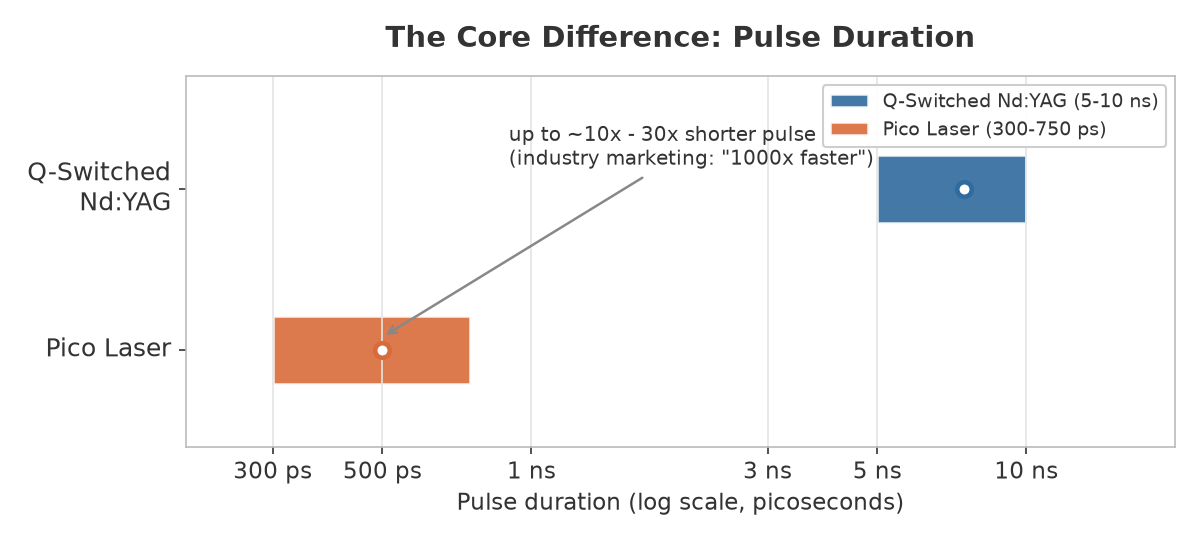
| Pulse speed | Nanosecond (billionth of a second) | Picosecond (trillionth of a second) |
| How it breaks pigment | Photothermal (heat) | Photoacoustic (shockwave) |
| Sessions for average tattoo | 6–12 | 4–8 |
| Pain & downtime | Moderate | Mild to moderate, slightly less downtime |
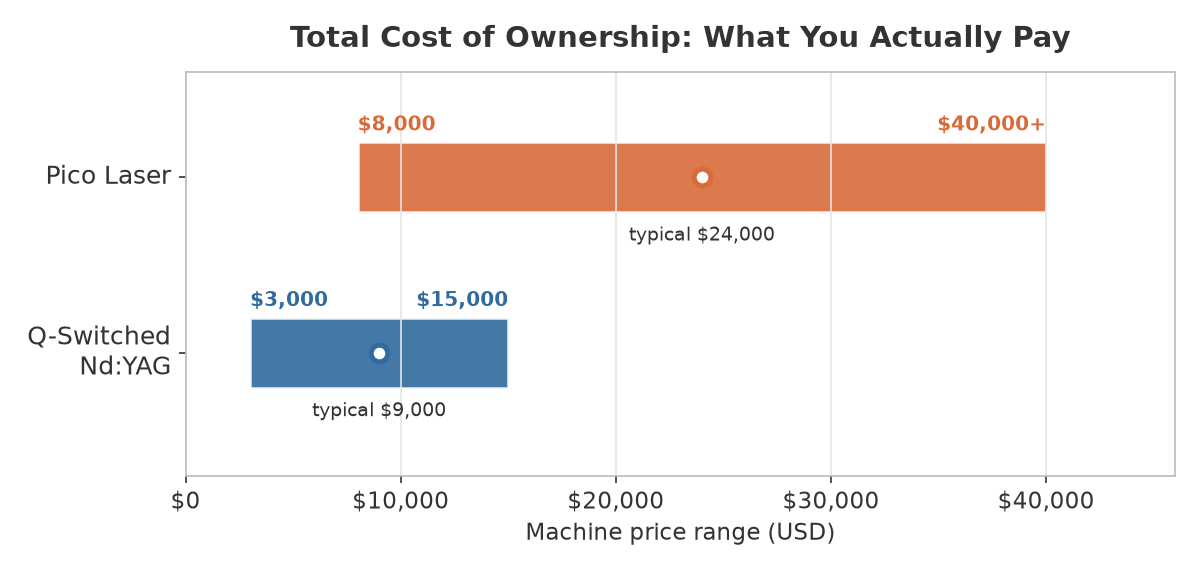
| Typical price range | $3,000–$15,000 | $8,000–$40,000+ |
| Per-session client pricing | Mid-range | Premium |
| ROI profile | Faster payback | Higher margin per session |
| Best buyer profile | New salons, budget-conscious, classic services | Established clinics, premium clients, fast results |
How These Lasers Actually Work
Q-Switched Nd:YAG — The Veteran Workhorse
Q-Switched Nd:YAG has been around since the 1990s. It fires nanosecond pulses — one-billionth of a second — mainly by photothermal action: the energy heats ink or pigment until it breaks into pieces your lymphatic system clears over the following weeks. Think of a hammer hitting glass: it works, it's proven, and millions of treatments have been performed with it. If you're just starting your laser business, this is the machine that trained half the aestheticians in the industry.
Pico Laser — The New Kid With the Faster Pulse
Pico fires picosecond pulses — one-trillionth of a second, roughly a thousand times faster — creating a photoacoustic (shockwave) effect that shatters pigment mechanically instead of just heating it. Same hammer, but hitting so fast it sends a shockwave through the whole pane: smaller particles, less heat spread to surrounding skin. That's why pico is often gentler and handles stubborn ink and pigment that Q-Switched struggles with.
The One-Sentence Difference (Your Client-Worthy Analogy)
Here's the line I use with clients — steal it:
"Q-Switched is like a hammer — it breaks pigment with heat. Pico is like a jackhammer on fast-forward — it shatters pigment with a shockwave. Both break the stone; one just does it in smaller pieces, faster."
That one sentence has closed more consultations for me than any spec sheet.
Tattoo Removal — Q-Switched vs Pico, Head to Head
Which One Clears Ink Faster?
Faster pulse = smaller particles = fewer sessions — the pico advantage. For professional, dense, multi-layer tattoos, pico clears ink in fewer sessions, meaning happier clients and shorter treatment plans that directly affect your booking calendar and reputation. That said, "faster" doesn't make Q-Switched obsolete: for the average black-ink tattoo — still the most common request — a well-operated Q-Switched gets the job done; you just plan for a few more sessions.
Black Ink, Colored Ink, and the Tough Cases
Black ink: Both handle it well. Q-Switched's 1064nm wavelength targets black beautifully; pico does it faster.
Green and blue ink: Q-Switched struggles — those colors need different wavelengths and more energy. Pico's shockwave breaks them more effectively, especially with a 532nm or 785nm handpiece.
Old, faded, or amateur tattoos: Easier for both — light, scattered ink responds well to Q-Switched.
Professional, dense, or scarred tattoos: Pico is the better bet; the photoacoustic effect handles dense ink without as much tissue trauma.
Session Counts Clients Actually Ask About
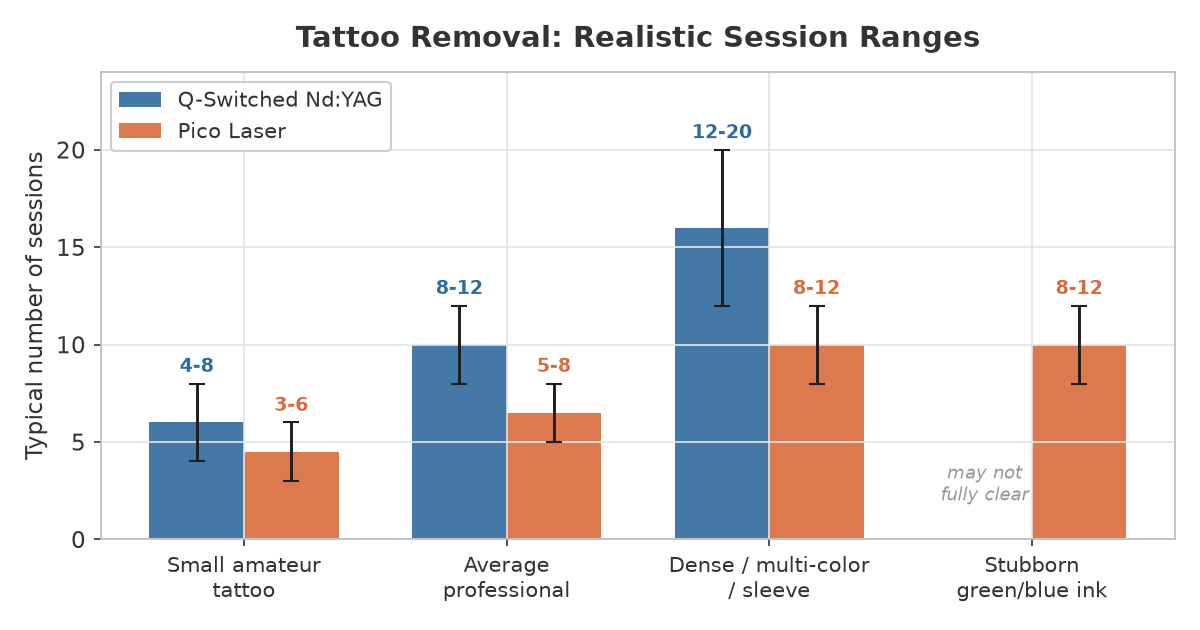
Clients always ask, "How many sessions?" It varies by ink, age, depth, and location, but here's a realistic range to quote:
| Tattoo type | Q-Switched (typical sessions) | Pico (typical sessions) |
|---|---|---|
| Small amateur tattoo | 4–8 | 3–6 |
| Average professional tattoo | 8–12 | 5–8 |
| Dense / multi-color / sleeve | 12–20+ | 8–12 |
| Stubborn green/blue ink | May not fully clear | 8–12 with correct handpiece |
Rule of thumb: quote the higher end of the range, then delight clients when they finish early. That's how you get referrals.
Pigmentation & Skin Concerns — Where Each Machine Shines
Tattoo removal brings people in the door; pigmentation keeps the machine busy between tattoo clients.
The Pigmentation Removal Laser Angle (Melasma, Sunspots, Freckles)
Q-Switched Nd:YAG has been the gold standard for pigmentation for years — sunspots, freckles, age spots, even melasma in skilled hands. The 1064nm wavelength penetrates deep without over-heating the surface; 532nm tackles superficial brown spots.
Pico adds a new tool: its shockwave breaks pigment into even finer dust, so it can treat stubborn or mixed pigmentation that doesn't respond to Q-Switched. For melasma — notoriously difficult and needing a gentle, low-fluence approach — pico's "toning" mode is popular in many markets, though results depend heavily on the practitioner. Honest advice: if your client base is mostly sunspots and freckles, Q-Switched will earn its keep; if you treat complex melasma and resistant pigmentation regularly, pico gives you more options.
The Skin Rejuvenation Bonus
Here's where pico quietly wins hearts. Its photoacoustic effect doesn't just break pigment — it stimulates collagen and improves skin texture, which is why "Pico Rejuvenation" or "Pico Toning" sits on premium clinic menus as a clean add-on service at a premium. Q-Switched can also improve tone, but less dramatically — most owners sell it primarily as a tattoo and pigmentation machine, then build rejuvenation with other treatments.
Darker Skin Types — A Safety Note
If you work with Fitzpatrick skin types IV–VI (darker skin), this is your most important consideration: higher energy + more heat = higher risk of post-inflammatory hyperpigmentation (PIH) and burns.
Q-Switched 1064nm is relatively safe on darker skin when parameters are set correctly and you patch test first.
Pico's shorter pulse means less heat spread to surrounding tissue — many practitioners find it gentler on darker skin.
The machine matters less than the operator: a cautious practitioner with a budget machine beats a reckless one with a $50,000 pico. Train your staff, patch test, start low, go slow.
Pain, Downtime, and Safety — What Your Clients Will Feel
Your clients don't care about wavelengths — they care about "will it hurt?" and "how long am I red?"
Pain Level Comparison and Numbing
Both machines feel like a rubber band snap or a hot pinprick; pico is generally reported as slightly less painful because the shorter pulse means less heat buildup. Honestly, with a good topical numbing cream (30–45 minutes before) and a cooling handpiece, most clients tolerate both fine.
Redness, Swelling, and Recovery Time
Q-Switched: Redness and some swelling for 24–72 hours; treated spots may scab and flake over 5–10 days. Plan downtime around social events.
Pico: Redness is typically milder and resolves faster — often within a few hours to a day. Less scabbing, less "I look like I have a rash" panic.
For a busy clinic, shorter downtime means happier clients and more repeat bookings — a real business advantage, not just a comfort one.
Risk of Burns and PIH — and How to Minimize It
Most "laser horror stories" come from operator error, not the machine. Both technologies can burn if settings are too high, cooling is poor, or the skin is untested — and PIH is the bigger risk on darker skin.
Minimize it:
Patch test every new client, especially darker skin types.
Start with conservative fluence, then build up.
Use a cooling tip or cryo device.
Space sessions 4–6 weeks apart — impatience causes complications.
Make clients use sunscreen religiously. A client who skips SPF will blame your machine, not their beach day.
The Buyer's Math — Cost, ROI, and Which Machine Pays for Itself Faster
How Much Do These Machines Actually Cost?
Prices range widely by brand, energy specs, handpieces, and whether you buy from a distributor or a factory. Here's a realistic total-cost-of-ownership picture:
| Cost item | Q-Switched Nd:YAG | Pico Laser |
|---|---|---|
| Upfront machine cost | $3,000–$15,000 | $8,000–$40,000+ |
| Handpieces typically included | 2 (1064nm + 532nm) | 2–3 (1064, 532, optional 785/zoom) |
| Consumables / maintenance | Low | Low to moderate |
| Training value | Huge (widely understood) | Needs specialized training |
| Resale / demand | Steady | Growing, premium |
If you see a "laser machine for sale" priced suspiciously low, ask about the laser source, cooling system, and certifications — cheap machines that burn clients cost you far more in the long run.
Per-Session Pricing and Break-Even Scenarios
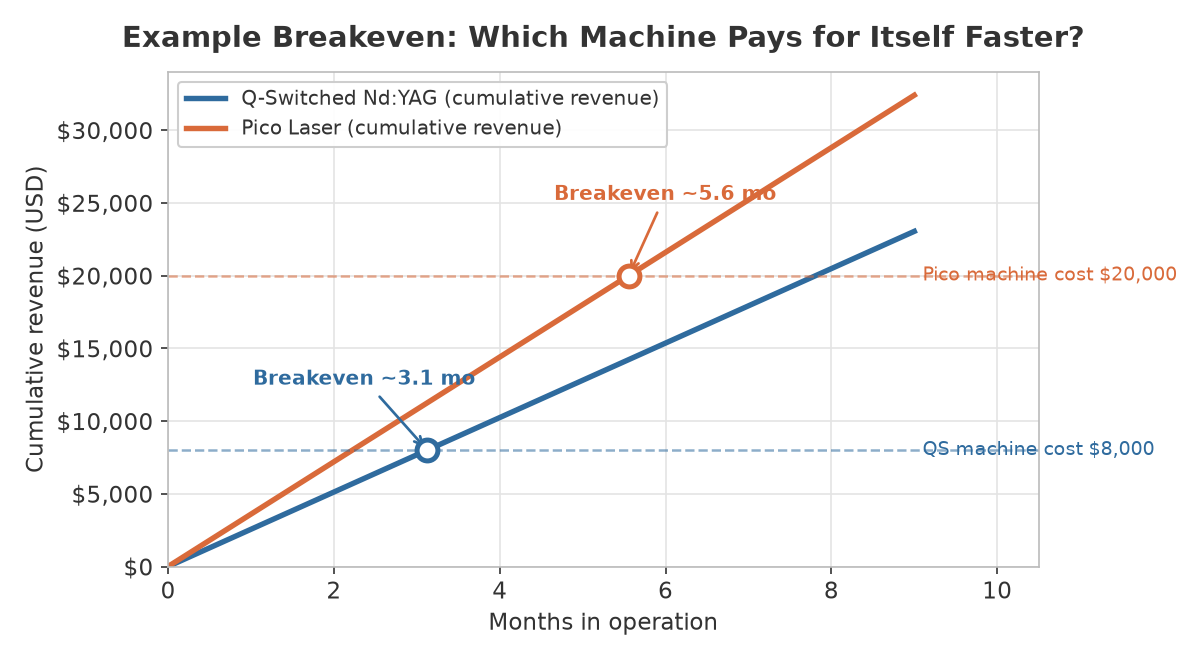
Here's a simple breakeven model with realistic mid-market numbers — adjust and run your own math.
| Scenario | Q-Switched | Pico |
|---|---|---|
| Machine price (example) | $8,000 | $20,000 |
| Avg per-session charge | $80 | $150 |
| Sessions per week (realistic) | 8 | 6 |
| Weekly revenue | $640 | $900 |
| Monthly revenue (4 weeks) | $2,560 | $3,600 |
| Months to break even | ~3.1 | ~5.6 |
The headline: Q-Switched pays for itself faster at these numbers; pico earns more per session once it's running. Neither is wrong — it's about your cash flow and client base. Bootstrapping a new salon? Faster payback matters. Established clinic with premium clients? Pico's margin is worth the wait.
The Distributor / Agent Angle — Why Resellers Care
If you're an agent or distributor, your math is different: you don't run treatments, you sell machines.
Q-Switched is your volume product — budget-conscious salons understand it, trust it, and buy it with less education needed. Lower price point, easier close.
Pico is your margin product — higher ticket, premium positioning, but your customer needs more convincing and will expect better after-sales support and training.
Smart distributors carry both — Q-Switched as the "starter," pico as the upsell when the client's business grows. That's how you build a pipeline instead of a one-off sale.
Should You Add IPL to the Mix? (IPL vs Q-Switched vs Pico)
Quick clarification, because buyers confuse these constantly:
IPL (Intense Pulsed Light): Broad-spectrum light, not a true laser. Great for hair removal, redness, and light photo-rejuvenation — but not the tool for tough tattoos or deep pigmentation.
Q-Switched: True laser. The pigmentation removal laser and black-ink tattoo specialist.
Pico: True laser, faster pulse, premium tattoo and pigmentation work.
The combo that works in successful clinics: IPL for hair removal and maintenance + one of the lasers for tattoos and pigmentation. IPL brings volume; the laser brings higher-ticket treatments. If you can only buy one machine, buy the laser that matches your main service — then add IPL when the booking sheet justifies it.
How to Choose a Q-Switched ND YAG Laser machine?
Step 1 — Match the Machine to Your Service Menu
Write down your top three revenue services today, and the top three you want next year.
Mostly hair removal and light skin treatments? Start with IPL, add Q-Switched for pigmentation.
Tattoo removal is your flagship? Buy the best laser you can afford — pico if your market pays premium, Q-Switched if you're price-sensitive.
Pigmentation is your bread and butter? A solid Q-Switched Nd:YAG covers 80% of cases; pico covers the other 20% with extra finesse.
Step 2 — Read the Specs That Actually Matter
Ignore the marketing fluff. Look for:
Energy output (mJ): More isn't always better, but you need enough for stubborn ink.
Spot size: Larger spot sizes treat faster — that's billable time.
Repetition rate (Hz): Higher Hz = faster treatments.
Cooling system: Non-negotiable for safety and comfort.
Handpieces included: At minimum, you want 1064nm and 532nm.
Warranty and certifications: CE, FDA, or regional approvals matter for insurance and client trust.
Step 3 — Verify Quality Before You Pay
Buying a laser isn't like buying a phone. Before you hand over money:
Ask for a live demo or video of it actually firing.
Ask about the laser source and cooling components — these are the parts that fail.
Check the supplier's history: years in business, export experience, client references.
Read reviews from other salon owners — not just the supplier's website.
Step 4 — Training, OEM, and After-Sales: The Hidden Half of the Deal
The machine is only half the deal — the other half is what happens after you pay. A machine you can't operate safely is a liability; one with no parts or support is a paperweight in six months. That's why the supplier matters as much as the device — and why, if you're building a brand (your logo on the machine, your own service names, your own packaging), you want a manufacturer that treats customization as a standard service, not a hassle. The point isn't the brand — it's the checklist: training, OEM flexibility, and QC are part of the product. Ask every supplier about them before you buy.
FAQ — People Also Ask (What Buyers and Clients Google)
Short answers to the questions buyers and their clients type into Google every day.
1. Is a Q-Switched Nd:YAG laser good for tattoo removal?
Yes — it's one of the most proven tools for black-ink tattoo removal. It heats the ink with nanosecond pulses, breaking it into particles your body clears over a few weeks. For most black-ink tattoos it delivers solid results at a much lower machine cost than pico, making it the smart entry-level choice for salons.
2. What is the difference between Q-Switched and Pico laser?
It's pulse speed. Q-Switched fires in nanoseconds (billionths of a second) and breaks pigment with heat; Pico fires in picoseconds (trillionths of a second) and shatters pigment with a shockwave. Faster pulses mean smaller particles, fewer sessions, and often less discomfort — which is why pico usually costs more.
3. How many sessions to remove a tattoo with pico laser?
Most tattoos need 4 to 8 sessions with pico, depending on ink density, color, depth, and skin type. Professional, multi-color, or sleeve tattoos may need 8 to 12. Sessions are spaced 4 to 6 weeks apart so your body can clear the ink and your skin can recover.
4. Can a Q-Switched laser remove colored tattoos?
Black ink is where Q-Switched performs best. Some colors respond to specific wavelengths — red responds to 532nm, for example — but stubborn colors like green and blue are harder. If you treat a lot of colored tattoos, pico with multiple handpieces is the stronger choice.
5. Which laser is best for pigmentation removal?
For classic sunspots and freckles, a Q-Switched Nd:YAG is the trusted pigmentation removal laser. For stubborn or mixed pigmentation like melasma, pico's gentler shockwave action gives practitioners more options. The right choice depends on the skin types and conditions you treat most.
6. How much does a Q-Switched Nd:YAG laser machine cost?
Prices vary widely by brand, energy, and features — from roughly $3,000 for a basic unit to $15,000+ for a full-featured model. When you see a "laser machine for sale" at a very low price, verify the laser source, cooling system, and certifications before buying.
7. Is pico laser safe for darker skin?
Yes, when used correctly. Pico's very short pulse creates less heat buildup, which lowers the risk of burns and post-inflammatory hyperpigmentation on darker skin. Still, always patch test, start with low settings, and space treatments 4 to 6 weeks apart.
8. Can I do tattoo removal with IPL?
No. IPL is not a true laser and is not the right tool for tattoo removal. It emits broad-spectrum light that can't target ink precisely and may cause burns or scarring. Use a proper Q-Switched Nd:YAG or pico laser — and leave IPL for hair removal and photo-rejuvenation.
Conclusion
Three things worth remembering before you spend a dollar:
No single "best" laser — only the best fit for your business. Match the machine to your service menu, client base, and budget. Q-Switched is the reliable workhorse that pays for itself fast; pico earns more per session once you have the clients for it.
The operator matters more than the machine. A cautious, well-trained aesthetician with a mid-range Q-Switched outperforms a reckless one with a top-shelf pico. Budget for training, not just hardware.
The supplier is half the purchase. Training, OEM customization, spare parts, and after-sales support decide whether your machine makes you money or collects dust. Evaluate the partner as carefully as the price tag.
Fit, training, and the partner behind the machine — get those three right, and the rest is just good business.
Ready to Choose Your Next Laser Machine?
Every clinic is different, and the best laser is the one that matches your treatment goals and client needs. Contact Krysmed Technology for honest advice, OEM customization, and reliable factory support before you invest.
Our Contact
Ready to Elevate Your Business with Krysmed?
Let’s discuss your needs and find the best solution for your business. Our experts are here to provide personalized recommendations tailored to your business needs.
-
Call For Inquiry
-
Send Us Email
info@krysmed.com
Get A Custom Quote Now!
We value your privacy and guarantee a prompt, professional reply.
 WhatsApp
 info@krysmed.com
 +86 19867944875