

News
27
Aug
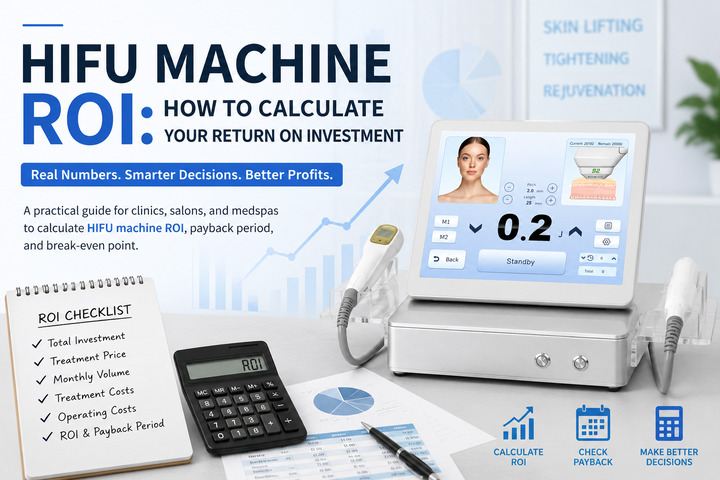
HIFU Machine ROI: How to Calculate Your Return on Investment
After more than 15 years of working with clinics, salons, and distributors around the world, we've seen a clear pattern: the buyers who get the most value from a HIFU machine investment are the ones who understand their potential return before they place the order. This guide walks you through the numbers step by step — the same math we wish every buyer ran before placing an order. No fluff, no “guaranteed profits,” just a practical way to estimate your HIFU machine ROI, payback period, and break-even point.
What Is HIFU Machine ROI?
ROI, or return on investment, measures how much profit an investment generates compared with the money invested. If you skip this step, you're not buying a machine — you're buying a very expensive hope.
ROI vs. Payback Period
ROI measures profitability over a defined period, while the payback period tells you how long it takes to recover the initial investment. For most clinic owners, both numbers matter: ROI shows the bigger picture, while payback tells you when the investment has effectively paid for itself.
Why the Math Matters Before You Buy
We've spoken with buyers who purchased equipment before working out how many treatments they actually needed to sell. The machine itself wasn't necessarily the problem — the pricing, booking volume, and cost assumptions were. HIFU machine profitability depends heavily on how you price the treatment, how often the machine is used, and what it costs you to deliver each treatment. That's what the calculations below are designed to help you estimate.
Start With the True Cost
The price on the invoice is only part of what you'll actually spend. For a useful ROI calculation, start with your total initial investment, then separate your ongoing operating costs.
Machine Price vs. Total Investment
HIFU machine pricing varies significantly depending on technology, configuration, cartridge system, certification, warranty, training, support, and market. Rather than treating a global price range as a benchmark, use the quotation for the specific machine you're considering.
For example, a professional HIFU system may involve several different costs beyond the machine itself:
| Cost Item | What to Include |
|---|---|
| HIFU Machine | Purchase price and selected configuration |
| Initial Cartridges | Cartridge types and quantities you plan to keep in stock |
| Shipping & Customs | Freight, duties, taxes, and local charges |
| Training | Operator training and certification, if applicable |
| Launch Marketing | Advertising, promotions, content, and introductory offers |
| Installation / Setup | Local installation or technical assistance |
| Spare Parts | Reasonable maintenance or replacement buffer |
The goal is to calculate the amount of money you actually need to put into the business before the HIFU service starts generating revenue.
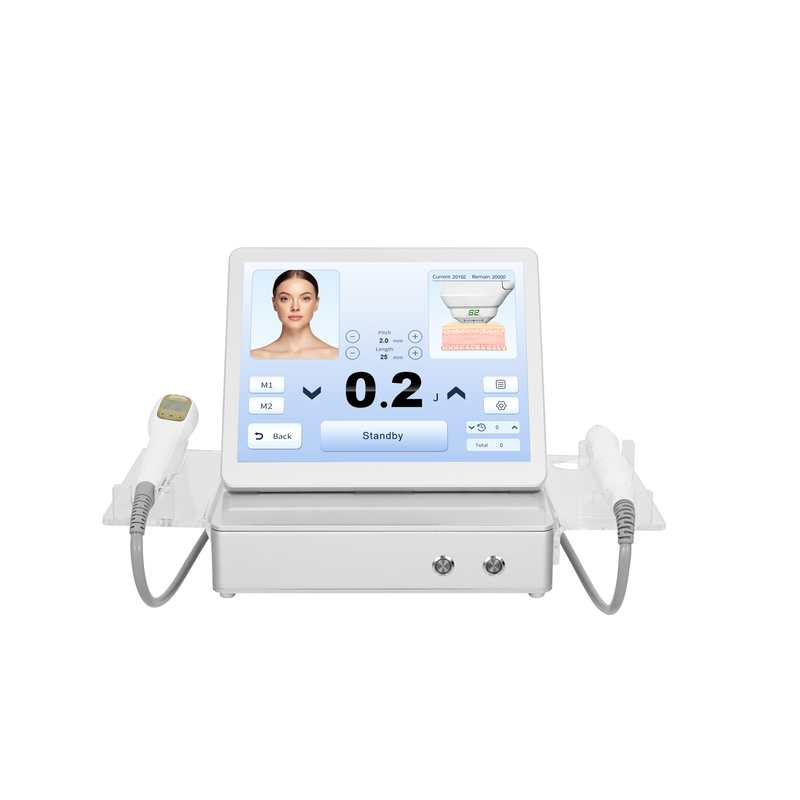
A Real Example: DermaLift SD HIFU
Let's use a real Krysmed configuration to show how the cartridge calculation works.
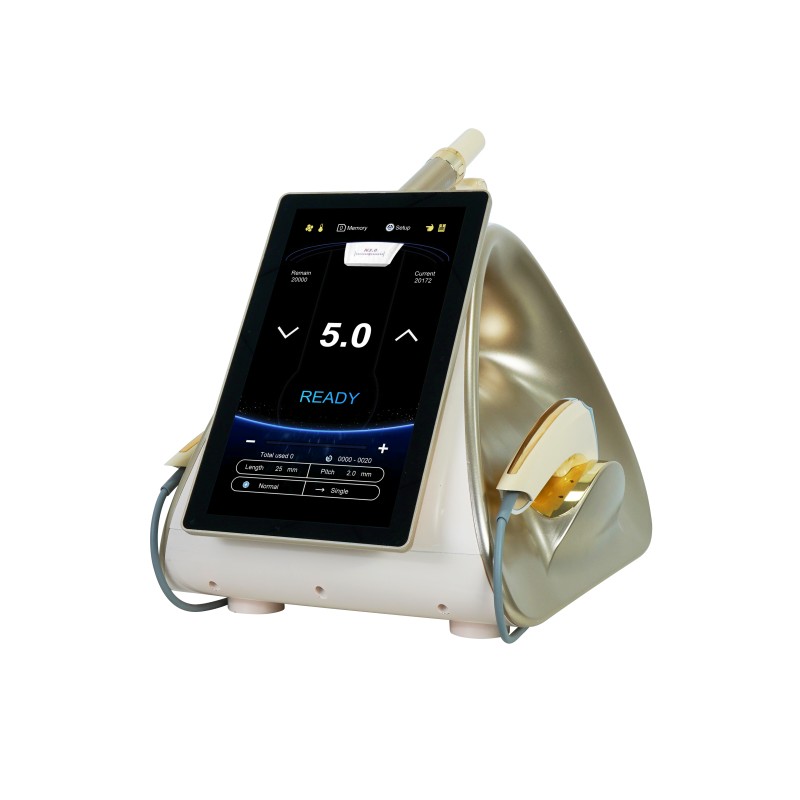
The DermaLift SD HIFU is priced at $2,850. A cartridge costs $250, with the example configuration including four 60,000-shot cartridges and three 20,000-shot cartridges.
That gives you:
| Item | Quantity | Shots Each | Total Shots | Cost |
|---|---|---|---|---|
| 60,000-shot Cartridge | 4 | 60,000 | 240,000 | $1,000 |
| 20,000-shot Cartridge | 3 | 20,000 | 60,000 | $750 |
| Total | 7 | — | 300,000 | $1,750 |
If a clinic purchased all seven cartridges upfront, the machine plus this cartridge inventory would represent:
$2,850 + $1,750 = $4,600. That's before shipping, customs, taxes, training, or marketing. You don't necessarily need to purchase all seven cartridges at once. The point of this example is to show how to include consumables in your ROI model instead of looking only at the machine price.
Cartridges: Your Real Cost Per Shot
Cartridges are an ongoing operating cost, so their price matters when you calculate long-term profitability. But shot counts alone don't tell the whole story — cartridge type and treatment protocol also matter.
The basic formula is:
Cost per shot = Cartridge price ÷ usable shots
Using the DermaLift SD HIFU example:
$250 ÷ 60,000 = approximately $0.0042 per shot
For a 20,000-shot cartridge:
$250 ÷ 20,000 = $0.0125 per shot
That difference is why you should ask your supplier which cartridge is intended for each treatment area and how many shots a typical protocol uses.
| Cartridge Factor | Why It Matters |
|---|---|
| Cartridge Price | Determines your consumable cost |
| Rated Shot Count | Determines potential usage per cartridge |
| Cost Per Shot | Makes different cartridge systems easier to compare |
| Cartridge Type | Different cartridges may be used for different treatment depths or areas |
| Treatment Protocol | Determines how many shots are actually used |
| Replacement Availability | Reduces the risk of treatment downtime |
Don't compare cartridges on price alone. A cartridge that costs less per shot is only useful if it is suitable for the treatment protocol you actually offer.
Hidden Costs: Training, Marketing, Customs
Shipping, customs, taxes, training, launch marketing, staff time, and local setup can all affect your real investment. There isn't a universal percentage that works for every country, so don't simply add an arbitrary 25% or 30% to every machine quotation. Instead, ask your supplier for the delivered cost and add a reasonable contingency based on your market.
Calculate Your Treatment Revenue
Revenue is simple:
Treatment revenue = Price per treatment × Number of treatments
The difficult part isn't the formula. It's choosing numbers that have a realistic chance of happening.
How to Set Your Treatment Price
Your treatment price should reflect your local market, treatment area, provider expertise, positioning, operating costs, and the value of the service you offer.
Start by checking what several comparable clinics in your area charge for similar skin lifting and tightening services. Then make sure your price leaves enough margin after cartridge usage, staff time, room costs, marketing, payment fees, and other operating expenses.
Single Sessions vs. Packages
Single sessions are easy to calculate, but packages can create more predictable bookings and cash flow.
If you offer a discounted package, calculate ROI using the actual revenue collected after the discount, not the advertised single-session price. Otherwise, your spreadsheet will look better than your bank account.
How Many Treatments Can You Actually Book?
This is one of the easiest numbers to overestimate.
Instead of using one optimistic booking figure, build three scenarios:
| Booking Scenario | Treatments / Month | Purpose |
|---|---|---|
| Conservative | 5 | Stress-test the investment |
| Expected | 15 | Main planning scenario |
| Optimistic | 30 | Understand the potential upside |
These are example assumptions, not industry benchmarks. If you already operate a clinic, use your existing booking data. If you're launching HIFU for the first time, be conservative. Your HIFU treatment revenue forecast is only as good as your booking assumption.
The ROI Formula, Step by Step
Once you know your investment, treatment price, volume, and costs, the calculation becomes much easier.
Monthly Profit: Revenue Minus Real Costs
It's useful to separate contribution profit from operating profit.
Contribution profit per treatment = Treatment price − Variable cost per treatment
Variable costs may include cartridge usage, disposable supplies, payment fees, and other costs that increase directly with each treatment.
Then:
Monthly contribution profit = Contribution profit per treatment × Treatments per month
For a more complete business calculation:
Operating profit = Monthly contribution profit − Allocated fixed costs
Fixed costs can include staff salaries, room costs, rent, insurance, software, and allocated marketing expenses.
This distinction matters because contribution profit tells you how much each additional treatment contributes, while operating profit gives you a more realistic picture of the money the HIFU service contributes to the business after allocated overhead.
ROI: Measure It Over a Defined Period
ROI should always be tied to a specific period.
A simple formula is:
ROI = (Profit generated during the period − Initial investment) ÷ Initial investment × 100%
For example, if a clinic invests $4,000 and generates $12,000 in profit from the HIFU service during its first year:
ROI = ($12,000 − $4,000) ÷ $4,000 × 100% = 200%
This is a simplified example. In a real business, clearly define which costs are included in “profit” before comparing ROI between machines or suppliers.
Payback Period: How Fast Can You Break Even?
Payback period answers a different question:
Payback period = Initial investment ÷ Monthly operating profit
If your initial investment is $4,000 and your monthly operating profit is $1,000:
$4,000 ÷ $1,000 = 4 months
For treatment-level break-even, use contribution profit rather than allocated fixed costs:
Break-even treatments = Initial investment ÷ Contribution profit per treatment
For example:
$4,000 ÷ $200 = 20 treatments
This tells you approximately how many treatments are needed to recover the initial investment before considering the timing of monthly overhead.
Worked Example With Sample Numbers
Let's use a simple example to see how the numbers work together.
| Item | Example Value |
|---|---|
| HIFU machine | $3,000 |
| Initial cartridges, training & launch marketing | $1,000 |
| Total initial investment | $4,000 |
| Treatments per month | 15 |
| Price per treatment | $250 |
| Variable cost per treatment | $30 |
| Allocated fixed cost per month | $600 |
| Contribution profit per treatment | $220 |
| Monthly contribution profit | $3,300 |
| Monthly operating profit | $2,700 |
| Break-even treatments | 4,000 ÷ 220 ≈ 19 treatments |
| Illustrative payback period | $4,000 ÷ $2,700 ≈ 1.5 months |
The calculation works like this:
15 × ($250 − $30) = $3,300 contribution profit
Then:
$3,300 − $600 = $2,700 operating profit
And:
$4,000 ÷ $2,700 ≈ 1.5 months
These are illustrative assumptions, not a promise of actual clinic performance. If your booking volume drops to 5 treatments per month, the result will look very different.
That's exactly why the next section matters.
Three Typical ROI Scenarios
The same HIFU machine can produce very different financial results depending on pricing, treatment volume, and operating costs.
| Scenario | Initial Investment | Price/Session | Sessions/Mo | Monthly Operating Profit | Illustrative Payback |
|---|---|---|---|---|---|
| Conservative | $2,500 | $150 | 5 | $400 | ~6.3 months |
| Expected | $4,000 | $250 | 15 | $2,700 | ~1.5 months |
| Strong demand | $10,000 | $350 | 25 | $6,125 | ~1.6 months |
These are illustrative scenarios built from sample assumptions, not industry averages or guarantees.
Notice something important: the high-volume business doesn't necessarily have the shortest payback period because it also has a much larger initial investment.
More revenue doesn't automatically mean a better investment. The relationship between investment, margin, and utilization is what matters.
Conservative: The Small Salon Adding a New Service
Lower volume and a smaller initial investment can make the service easier to test, but the business needs enough margin per treatment to justify the machine and staff time.
Expected: The Growing Clinic
A clinic with an established client base, multiple treatment rooms, and a basic marketing system may have more opportunities to build HIFU bookings and package sales.
Strong Demand: The High-Volume Medspa
At higher treatment volumes, cartridge availability, therapist training, scheduling, treatment consistency, and technical support become increasingly important. The financial model may look attractive, but operational reliability matters just as much.
The Numbers Nobody Talks About
This is where an ROI calculation becomes more useful than a sales brochure. The costs that affect profitability aren't always visible on the machine quotation.
HIFU Is a Repeat-Cycle Business, Not a One-Off
HIFU results develop over time and may last for months, so some clients may return for maintenance treatments. However, the timing varies by treatment area, protocol, client needs, and local practice.
Treat every satisfied client as the potential beginning of a longer relationship, not simply a completed appointment. Your recall and follow-up system can have a meaningful impact on long-term HIFU profitability.
No-Shows, Refunds, and Complaint Costs
Some bookings will be cancelled, rescheduled, or refunded. Those events reduce the revenue your calendar appears to promise.
If you already have booking data, use your actual cancellation and no-show rate. If you're new to HIFU, use a conservative assumption and update the model after three to six months of real data.
Seasonality and Slow Months
Aesthetic demand can vary because of holidays, local events, weather, consumer spending, and market-specific buying patterns.
There is no universal “slow month” that applies to every clinic. If you have enough historical data, build a 12-month forecast instead of assuming every month will perform like your best month.
When a Cheap Machine Costs You More
A low purchase price can be attractive, but it doesn't tell you the total cost of ownership.
Downtime, inconsistent performance, expensive cartridges, limited technical support, unavailable spare parts, or unclear warranty terms can all affect the real economics of an equipment investment.
The better question isn't:
“Which machine is cheapest?”
It's:
“Which machine gives me the most predictable cost and performance over the period I plan to use it?”
What Moves Your HIFU Machine Profitability the Most
Not all variables have the same impact. In most business models, treatment volume and pricing can change profitability much more dramatically than small differences in consumable cost.
Treatment Price and Positioning
Cutting your price simply to match the cheapest competitor can reduce your margin without generating enough additional demand to compensate.
Instead, position your HIFU service around the treatment experience, provider expertise, client results, service quality, and the value you can actually demonstrate.
Client Volume and Machine Utilization
An underused machine is an underused investment.
Increasing monthly treatments from 5 to 15 can have a much larger effect on payback than saving a few cents on each shot. That's why your launch strategy, local marketing, consultation process, and follow-up system matter almost as much as the machine itself.
Cartridge Cost Per Shot
Cartridge pricing becomes increasingly important as treatment volume grows.
Use the actual cartridge price and shot count from each supplier and calculate:
Cost per shot = Cartridge price ÷ usable shots
Then estimate how many shots your typical treatment protocol uses.
This gives you a much more useful comparison than simply asking which supplier has the lowest cartridge price.
How to Reach Break-Even Faster
Once the machine is installed, the focus should shift from buying equipment to building a predictable treatment service around it.
Sell Packages Upfront
Packages can make future bookings more predictable and help your team plan treatment demand.
Just make sure your ROI model uses the actual discounted package revenue rather than the full single-session price.
Build a Repeat Booking Habit
Don't wait for clients to remember when they may need another treatment. Explain the expected treatment and maintenance timeline, follow up after the appointment, and give clients a clear reason to stay connected with your clinic.
Your ROI is built over the client relationship, not just the first appointment.
Fill Your Idle Hours
Look at your calendar and identify underused time slots.
Off-peak promotions, referral campaigns, add-on treatment areas, or targeted local marketing can help increase machine utilization without permanently discounting your core service.
An idle machine generates no treatment revenue.
Don't Judge a Machine by Price Alone
The lowest quotation isn't necessarily the lowest-cost investment. Look at what you'll actually spend and receive over the period you plan to operate the machine.
Total Cost of Ownership
A useful comparison should include:
Total cost of ownership = Machine + Consumables + Shipping/Duties + Training + Maintenance + Other Operating Costs
For example, a machine with a slightly higher purchase price may have better long-term economics if its cartridge cost, warranty coverage, technical support, and downtime risk are lower.
The goal isn't to find the lowest purchase price. It's to find the combination of purchase cost + operating cost + support + expected utilization that makes sense for your business.
Questions to Ask Your Supplier
Ask these questions before placing an order:
How many usable shots does each cartridge provide?
What is the replacement cartridge price?
Which cartridge types are available for different treatment areas?
What are the warranty terms, and how are repairs handled in my country?
What training is included?
What technical support is available after delivery?
Can you provide genuine before-and-after results from your equipment?
What spare parts or consumables should I keep in stock?
A supplier who gives clear answers to these questions is much easier to evaluate than one who only focuses on the machine's headline price.
When You Should NOT Buy a HIFU Machine
Yes, there are situations where buying a HIFU machine may not make sense yet.
A machine that sits idle doesn't help your business — or your equipment supplier.
Your Client Demand Is Too Low
If your existing clients have little interest in lifting or skin tightening and you don't have a realistic plan to create demand, the machine may spend more time sitting in the treatment room than generating revenue.
The machine doesn't create demand by itself. It gives you a tool for serving demand you already have or can realistically build.
Your Treatment Price Is Too Low
If local pricing is so low that your margin can't cover cartridge usage, staff time, and other operating costs, buying a machine won't solve the underlying problem.
Fix the pricing and positioning model first.
You Don't Have a Sales Plan
A machine in the treatment room doesn't sell itself.
You need a basic plan for launching the service, creating before-and-after content, communicating with existing clients, promoting packages, and following up with leads.
If you aren't ready to do that, waiting may be the smarter investment decision. If the numbers don't work before you buy, buying a more expensive machine won't fix the business model.
FAQ
How profitable is a HIFU machine?
A HIFU machine can be profitable when treatment pricing, booking volume, operating costs, and equipment investment are aligned. There is no universal profit figure because a small salon and a high-volume medspa can have very different business models.
How long does it take to recover the cost of a HIFU machine?
The payback period can range from a few months to longer than a year depending on machine cost, treatment pricing, booking volume, operating costs, and cartridge usage. The best way to estimate it is to calculate your own payback under conservative and expected booking scenarios.
How much does a HIFU treatment cost?
HIFU treatment prices vary significantly by country, treatment area, provider positioning, and local market conditions. Instead of relying on a global average, compare several similar clinics in your target market and calculate what price leaves you with a healthy operating margin.
How many HIFU treatments are needed to break even?
Divide your initial investment by your contribution profit per treatment.
For example, if your initial investment is $4,000 and you generate $200 in contribution profit per treatment:
$4,000 ÷ $200 = 20 treatments
Your actual break-even point will depend on your treatment price, consumable costs, and investment amount.
What is a good ROI for a HIFU machine?
There is no universal “good” ROI for every clinic. A better test is whether the investment remains financially viable under conservative treatment volume and realistic operating costs.
If your model only works when you assume a nearly full schedule and premium pricing, the investment deserves a closer look before you buy.
What costs should be included in HIFU ROI?
Include the machine price, cartridges, shipping and customs, training, marketing, staff time, room or facility costs, maintenance, payment fees, and other relevant operating expenses.
The more complete your cost model, the more useful your ROI calculation will be.
Is a cheaper HIFU machine better for ROI?
Not necessarily. A lower purchase price can improve the numbers initially, but higher consumable costs, downtime, limited technical support, or replacement expenses can change the picture over time.
Compare total cost of ownership rather than purchase price alone.
Is HIFU a good investment for a small beauty salon?
It can be, but only if the salon has enough local demand and can maintain a healthy margin per treatment. Run the conservative scenario first. If the investment still makes sense with realistic booking assumptions, it becomes easier to justify.
What should I ask my HIFU machine supplier?
Ask about cartridge pricing and shot counts, treatment protocols, warranty coverage, technical support, training, replacement parts, and genuine treatment results.
You should also ask for the total delivered cost so you know what the investment actually looks like after shipping and other charges.
Conclusion: Run the Numbers Before You Buy
A HIFU machine can be a profitable investment, but the return depends on more than the machine price. Before buying, calculate your HIFU machine ROI, treatment margin, expected booking volume, cartridge costs, and payback period under a realistic scenario—not a best-case forecast. The right HIFU machine is not necessarily the cheapest or most expensive option; it is the one that fits your business model and can deliver a predictable, sustainable return on investment.
Ready to Calculate Your HIFU Machine ROI?
If you're comparing HIFU machines for your clinic or salon, Krysmed Technology can provide the specifications, cartridge details, pricing, training, and support information you need to run the numbers accurately. Contact us to get the details for the DermaLift SD HIFU or discuss which HIFU machine configuration makes the most sense for your market and treatment plan.
Our Contact
Ready to Elevate Your Business with Krysmed?
Let’s discuss your needs and find the best solution for your business. Our experts are here to provide personalized recommendations tailored to your business needs.
-
Call For Inquiry
-
Send Us Email
info@krysmed.com
Get A Custom Quote Now!
We value your privacy and guarantee a prompt, professional reply.
 WhatsApp
 info@krysmed.com
 +86 19867944875