

News

31
Aug
Skin Analyzer ROI: How Fast Do Spas Actually Break Even?
Published by the Krysmed team · Last updated August 2026 · All figures in this article are illustration models with stated assumptions — they are planning tools, not industry benchmarks or guaranteed returns.
If you're looking at a skin analyzer quote and wondering how long before that money comes back, you're asking the right question. You'll often see "3–6 months ROI" quoted online as if it were physics — this article does something different: it shows you the math so you can run your own numbers and decide for yourself.
Why Most ROI Articles Get It Wrong
Many ROI calculators assume the machine gets used every day from day one. In practice, how often a skin analyzer actually gets used is the variable that moves the math the most.
The Metric Nobody Tracks: Cost per Actual Scan
Forget payback period for a second and ask what each scan actually costs you. Take the total investment, divide it by the number of scans you genuinely perform per year — the answer changes dramatically with usage:
Investment | Scans per Year | Equipment Cost per Scan |
$4,200 | 120 (light use) | $35.00 |
$4,200 | 480 (regular use) | $8.75 |
$4,200 | 1,000 (heavy use) | $4.20 |
That's the honest way to think about skin analyzer ROI: usage, not price, drives the cost per scan. And if a machine stops being used entirely, its cost per actual scan has no meaningful floor — which is why utilization deserves your attention before any feature comparison.
What Actually Pays Back a Skin Analyzer?
A skin analyzer doesn't make money by existing — it earns its keep through four doors. How much each door contributes depends on your business.
Paid Skin Analysis
Some spas charge 20–40 for a standalone skin analysis as a mini-service in its own right. It won't pay back the machine alone, but it can cover staff time and filter for clients who are genuinely considering treatment. Most owners treat it as a paid entry point, not a profit center.
More Treatment Conversions
This is usually the biggest lever. The scan gives the consultation something concrete to discuss — actual images and measurements — instead of relying entirely on what the client can see in the mirror. A concrete conversation makes it easier for a client to decide on a treatment plan, whichever plan that turns out to be.
Higher Client Value
A report in hand gives your recommendations a factual anchor, whether that's a serum, a home-care product, an add-on session, or a package. Clients who understand why something is being recommended tend to accept the plan more readily — and that's where average client value quietly climbs.
Repeat Visits
Before-and-after scans can become a practical rebooking tool. When clients can compare changes over time, it becomes much easier to explain why a follow-up appointment may make sense — the conversation shifts from selling to reviewing progress.
Start With the Real Investment
Before any math, be honest about what you're actually spending. The sticker price is only the beginning.
Machine Purchase Price
Skin analyzer pricing varies widely across markets and configurations, so we won't quote global price ranges that don't survive contact with reality. What matters for your ROI math is which investment level fits your consultation workflow:
Investment Level | Typical Business Use | The ROI Question to Ask |
Lower-cost systems | Basic consultation support | Can you generate enough scans to matter? |
Professional systems | Regular spa consultations | Can your conversion rate justify the investment? |
Advanced systems | High-end clinics, detailed analysis | Will the extra features actually generate extra revenue? |
Shipping, Setup and Training
Freight, taxes, calibration and staff training typically add a few hundred dollars to the bill. Model these in your planning assumptions from the start so month one doesn't surprise you.
Software and Maintenance
Many vendors charge a recurring subscription for cloud storage, updates or report exports — some don't. Whatever applies to your quote, it belongs in your monthly cost line, or your payback math starts on fiction.
The Hidden Cost: Staff Minutes per Scan
For planning purposes, you might allocate 10–15 staff minutes per scan and explanation — a few dollars in wages every time, depending on your pay structure. It's a small number individually, and it's a fair argument for charging for scans or folding them into a paid consultation.
Your Total Investment
Add it all up before you divide anything. Here's the worked example we'll use through this whole article — the assumptions are ours, and you should swap in your own:
Item | Cost |
Professional-tier skin analyzer (illustrative) | $3,500 |
Shipping, setup, training (illustrative) | $400 |
Software subscription, 6 months prepaid (illustrative) | $300 |
Total initial investment | $4,200 |
Monthly operating costs in this model: 110 (subscription + staff minutes + misc.). Keep this 4,200 / $110 pair in mind — every calculation below builds on it.
The Four Numbers That Drive ROI
Everything from here on runs on four variables. Nail these down for your own spa and you don't need anyone's calculator.
Monthly Skin Analysis Volume
How many scans can you realistically do? That depends on your consultation volume and whether scanning becomes part of your standard process. This is the number owners tend to overestimate most — count your actual monthly consultations before trusting any estimate.
Consultation Conversion Rate
Of those scans, how many become paying treatment clients? For this article, we'll model 15%, 25% and 35% as conservative, expected and strong planning scenarios. They're planning assumptions, not industry averages — your actual rate depends on your services, pricing and team.
Average Client Value
Don't count revenue — count net profit per converted client after product costs and commission. In our example we use $130 net per converted client as the planning figure. ROI math runs on net, not gross.
Monthly Operating Cost
Software, staff minutes, and any promotion you run to drive scans. Our model uses $110 a month — small, but it belongs in the formula.
Variable | Conservative | Expected | Strong |
Scans per month | 25 | 40 | 60 |
Conversion rate | 15% | 25% | 35% |
Net profit per converted client | $130 | $130 | $150 |
Monthly operating cost | $110 | $110 | $110 |
The Break-Even Math, Step by Step
Here's the whole calculation in plain English — plus the distinction most articles skip. If you can divide, you can do this.
Payback Period vs. ROI: Not the Same Thing
The title asks about ROI, so let's be precise. Payback period = Initial Investment ÷ Monthly Net Contribution — it tells you how long until you recover the investment. ROI over a defined period = (Net Contribution over that period − Initial Investment) ÷ Initial Investment × 100% — it tells you how much the investment earned. This article calculates both.
Break-Even in Plain English
Break-even is the moment your accumulated net contribution equals what you spent. Before that point, the machine still owes you money; after it, every scan contributes pure gain.
The Payback Formula: Investment ÷ Monthly Net Contribution
Monthly net contribution = scans × conversion rate × profit per client − monthly operating cost. Payback period = total investment ÷ that number. One line of arithmetic, no MBA required.
From "Months" to "How Many Clients"
"Payback in X months" sounds abstract, so flip it: at 130 net per converted client, our 4,200 investment needs about 33 converted clients. Spread over eight months, that's roughly 4–5 new treatment clients a month. Suddenly it feels negotiable — and countable.
The Ramp-Up Reality: Month 1 Is Not Month 6
A common operational risk is assuming the machine runs at full speed from day one. In a more realistic picture, you could model month-one usage at 40–50% of your eventual steady-state volume and month-three usage at 70–80% while staff build the habit. Pad your payback estimate with one extra month and you'll rarely be disappointed.
Three Planning Scenarios (Slow, Expected, Strong)
No honest article can tell you your payback period without your numbers — so instead, here are three planning scenarios on the same $4,200 investment. Treat them as illustration models, not predictions.
Conservative: The 9–12 Month Case
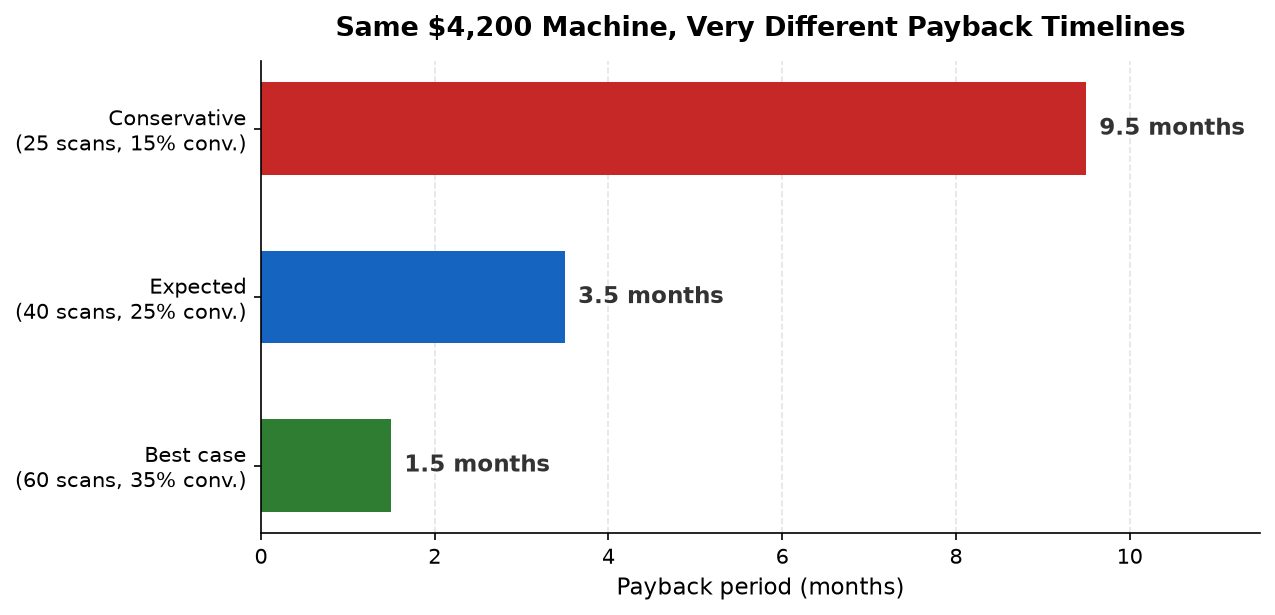
25 scans, 15% conversion, 130 net each — about 4 new clients and 410 of monthly net contribution. Payback lands around 10 months in this model. If you're budgeting for the purchase, this is the scenario to budget against.
Expected: The Main Planning Case
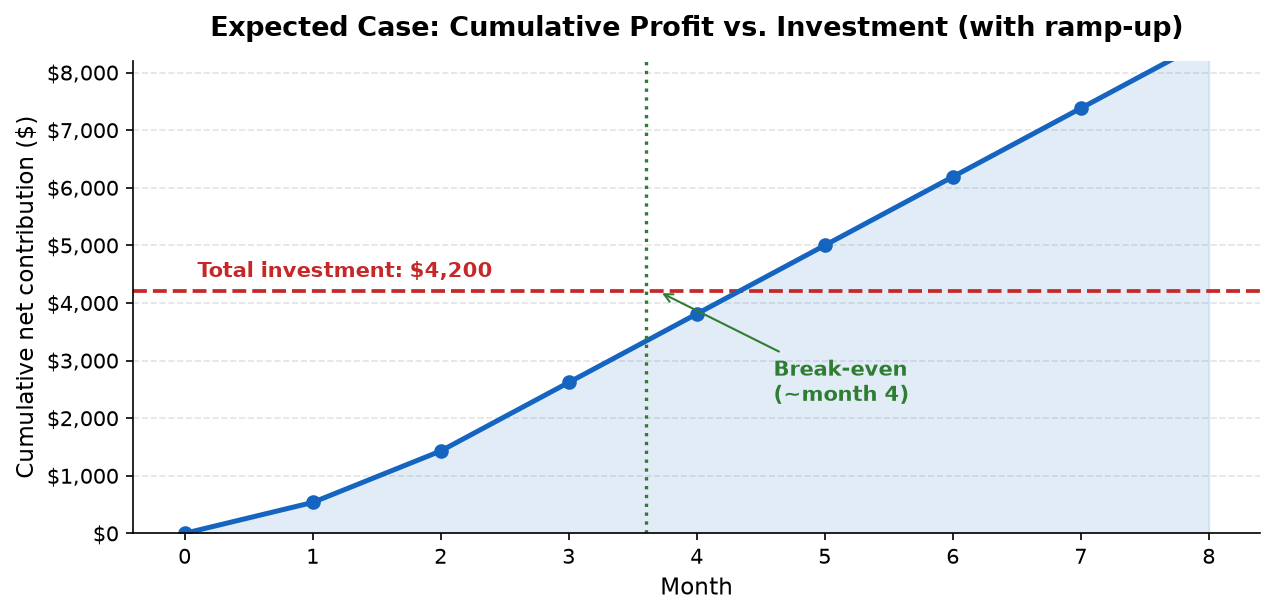
40 scans, 25% conversion, 130 net each — roughly 1,190 of monthly net contribution. In this model the machine pays for itself in about three and a half months. This is what our planning assumptions produce — it is not a promise, and it is not an industry average.
What the 12-Month ROI Actually Looks Like
Since the title says ROI, here it is properly calculated on the expected scenario — net gain after the investment is repaid, measured over the first year:
Metric | Amount |
Initial investment | $4,200 |
Monthly net contribution | $1,190 |
12-month net contribution | $14,280 |
12-month net gain | $10,080 |
12-month ROI | 240% |
Illustration only: 12-month ROI = (12-month net contribution − initial investment) ÷ initial investment × 100%. ROI depends entirely on the assumptions above and does not represent a guaranteed return. Run your own four numbers before treating any figure as a plan.
A Best-Case Illustration: The Six-Week Payback
60 scans, 35% conversion and $150 net per client produces a theoretical payback of about six weeks. It's mathematically valid — and it usually requires a high-volume consultation culture that already existed before the machine arrived. Treat this as a best-case illustration, not a target you put into a business plan.
What If Sales Are Slower?
Fold in the ramp-up and a couple of slow months, and the expected case stretches from 3.5 to roughly 5 months in this model. Building that buffer into your planning is simply prudent. A slow start is normal; a flat line at month six is the signal to revisit your process.
Scenario | Scans/Mo | Conversion | Payback (model) | How to Use It |
Conservative | 25 | 15% | ~10 months | Budget against this |
Expected | 40 | 25% | ~3.5–5 months | Plan around this |
Best case | 60 | 35% | ~6 weeks | Know it exists; don't bank on it |
How Many Clients Does It Take to Break Even?
Some owners think in clients, not months — fair enough. Here's the same model from that angle.
If You Charge for the Scan
At 25 per scan (credited toward treatment), 30 scans brings in 750 before anyone books a thing. In the conservative model, that alone pulls the payback point noticeably closer. Charging also filters for clients who are genuinely considering treatment.
If Analysis Is Free
Then treatment conversion and retail carry the whole load. You'll need about 33 converted clients at $130 net — roughly 4–5 additional treatment clients per month over eight months in our example. Free scans can work, but only with a proper consultation process behind them.
If It Lifts Package Sales
Say the scan helps lift package conversion from 20% to 26% across 100 monthly consultations — that's 6 additional package clients. At 130 net each, that's 780 of monthly contribution from one changed habit. For many spas, this is the single biggest lever in the model — and the one you can test cheapest.
If It Brings Clients Back
Repeat visits don't show up in payback math, but they keep contributing after it. A client who rebooks quarterly and stays engaged through progress scans is worth several hundred dollars of annual net profit in many service menus. Year two is where the investment often proves itself.
The Operational Risks Worth Knowing
None of the common failure patterns are about the hardware. They're about process — and all of them are avoidable.
The Month-3 Slump: When the Novelty Wears Off
Week one, everyone scans everyone. By month three, the scanner can quietly migrate to the storage room while the payback clock keeps running. The fix is procedural: build "scan in every consultation" into your SOP, not into your enthusiasm.
Scans Without a Script
If staff can't translate the report into a recommendation, the scan stays entertainment. Give your team a simple flow: show what the scan shows, connect it to a treatment option, suggest a date. Training beats features every time.
Low Traffic, Low Conversion — the Math Doesn't Lie
The formula is brutally honest: 10 scans a month at 15% conversion is under 2 new clients, and payback drifts past two years in this model. If traffic is the bottleneck, fix traffic first. A skin analyzer amplifies the consultation business you already have.
The Machine Sitting in the Storage Room
Out of sight is out of scans. Keeping the analyzer where consultations actually happen is the cheapest utilization strategy available — no promotion budget required.
Paying for Features That Don't Fit Your Workflow
Advanced capabilities like 3D visualization, additional light spectrums or AI-assisted grading can genuinely help — if they support how your team consults and how clients decide. The principle: pay for features that support your consultation workflow, not simply the longest feature list. A demo that dazzles but never gets used contributes nothing to ROI.
Five Moves That Cut Months Off Your Payback
Want to give the investment its best chance? These five habits separate fast payback from slow payback in almost every model you can build.
Use It in Every Consultation
Utilization is the strongest controllable variable in the entire formula — stronger than brand, features or price. Make the scan step one of every consult, no exceptions. The math does the rest.
Charge for the Scan, Credit It Toward Treatment
A $25 scan fee, credited against any treatment booked the same day, is a pricing structure worth testing. The fee covers staff time, discourages no-shows, and disappears for anyone who actually books. Everybody wins — including your payback period.
Make the Report Your Rebooking Tool
End every scan with a printed or emailed report that names the recommended next step and a suggested timeline. The report does the explaining while your front desk simply confirms the booking. Conversion climbs without pressure tactics.
Sell the Plan, Not Just the Scan
A one-off scan is a snapshot; a 3-month plan with progress scans is a program. Scan, treat, rescan, compare — the journey is what clients buy into. Programs are where client value and retention multiply.
Train Staff to Explain the Results
An analyzer produces data; a trained esthetician turns data into a decision. Role-play until every team member can walk a client through their own report in two minutes. Your conversion rate lives or dies here.
Is a Skin Analyzer Worth It for Your Spa?
Honest answer: it depends less on the machine than on your room. Here's the self-check we'd run before signing any purchase order.
A Good Fit for Consultation-Heavy Spas
If your monthly consultation volume is high and stable, the model above starts working in your favor — more scans means lower cost per scan and a faster path through break-even. The machine rewards businesses that already talk to clients about their skin.
New Spas: Use the Conservative Case
New businesses often overestimate how quickly traffic will build. Budget against the conservative scenario and treat anything faster as a bonus, not a baseline.
When a Lower-Cost System Makes More Sense
If your main goal is better consultations rather than advanced imaging, a lower-cost system with a disciplined team can outperform a premium system on ROI. Buy for workflow, not for wow factor.
When You Should NOT Buy One
No consultation culture, no one accountable for using the machine, or traffic you can't yet forecast? Fix those first — the analyzer market will still be there next year. The honest move is knowing when it's not your turn yet, and this article would rather tell you that than sell you a box.
People Also Ask
How Long Does It Take for a Skin Analyzer to Pay for Itself?
In our worked model, an established consultation-heavy spa recovers the investment in around 3–5 months, while a cautious scenario lands near 10 months. These are planning illustrations — your answer depends on your scan volume, conversion and client value.
Is a Skin Analysis Machine Worth the Investment?
It can be, if you'll use it in every consultation and your team can turn reports into treatment plans. It's rarely worth it as a demo-room attraction or a one-week novelty.
How Much Does a Professional Skin Analyzer Cost?
Pricing varies widely by market, configuration and capability tier — from lower-cost consultation units to advanced multi-spectral systems. Ask vendors for a complete quote including software, shipping and training, then build those numbers into your ROI model.
Can a Skin Analyzer Increase Spa Revenue?
Indirectly, yes. The revenue comes from higher conversion, larger packages, more retail and better retention; the scan is the trigger for those conversations, not the income line itself.
How Do You Calculate ROI for a Skin Analysis Machine?
Payback period = total investment ÷ monthly net contribution, where net contribution = scans × conversion rate × profit per converted client − monthly operating costs. For ROI over a period: (total net contribution − investment) ÷ investment × 100%. The same formula works for calculating skin analysis machine ROI — every supplier calculator boils down to these two lines.
Can You Charge Clients for Skin Analysis?
Yes — 20–40 is a common range, often credited toward a treatment booked the same day. Charging covers staff time and tends to filter for clients who are seriously considering treatment.
What Is the Break-Even Point for a Skin Analyzer?
It's the month your accumulated net contribution matches the total investment — about 33 converted clients in our $4,200 worked example. Calculate yours with your own four numbers rather than borrowing anyone else's.
Is a Skin Analyzer Profitable for a Small Spa?
A small spa with steady consultation traffic can reach payback within a year in our conservative model, and faster if conversion is strong. If consultation volume is still unpredictable, build traffic and process first — the hardware will wait.
Final Takeaway: Payback Is a Process, Not a Purchase
The cheapest machine is rarely the best ROI, and the most expensive one almost never is. Payback speed comes from scans done, clients converted and plans sold — all of which live in your process, not the price tag.
The Cheapest Machine Is Not the Best ROI
A bargain analyzer used twice a month costs more per scan than a premium one used daily. Match the investment level to your consultation workflow, then let discipline do the compounding.
Build Your Own ROI Model
Before accepting any supplier's "3–6 months" — including ours — run your own four numbers: monthly scans, conversion rate, net client value, operating cost. Ten minutes with a calculator beats three years of hoping.
Your 3-Question Self-Check Before Buying
Question | Green Light If... |
How many consultations do I actually do a month? | You know the exact number, and it can feed the model |
Who explains the report, and are they trained? | You can name the person and the script |
Where will the scanner physically live? | In the consultation room, not the closet |
Answer all three with numbers and names — then build your own ROI model and see what the machine has to earn. Answer "not sure" to any of them, and you've just found the thing to fix before spending a single dollar.
Our Contact
Ready to Elevate Your Business with Krysmed?
Let’s discuss your needs and find the best solution for your business. Our experts are here to provide personalized recommendations tailored to your business needs.
-
Call For Inquiry
-
Send Us Email
info@krysmed.com
Get A Custom Quote Now!
We value your privacy and guarantee a prompt, professional reply.
 WhatsApp
 info@krysmed.com
 +86 19867944875