

News
September 14, 2026

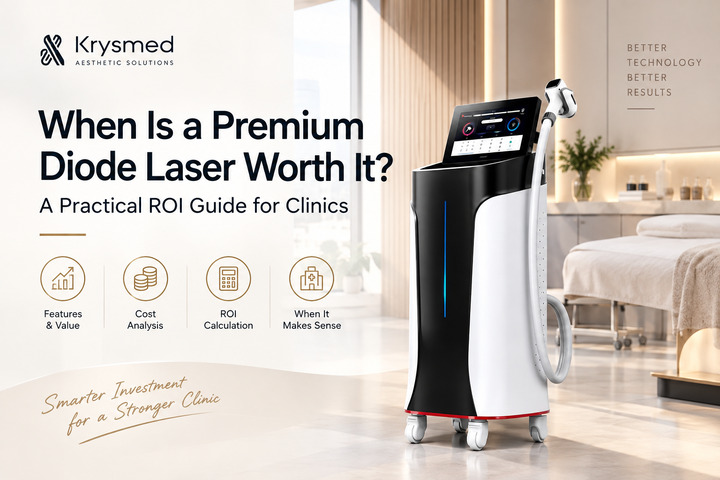
When Is a Premium Diode Laser Worth It? A Practical ROI Guide for Clinics
Short Answer
A premium diode laser is worth considering when your clinic has enough treatment demand to actually use its additional capabilities. Higher specifications such as advanced cooling, larger spot sizes, multiple wavelength options, higher flash capacity, treatment-data management and stronger after-sales support only create business value when they improve utilization, workflow or long-term ownership. For a new clinic with limited bookings, a practical professional system may be enough. For an established clinic, high-volume hair-removal business or premium aesthetic spa, the additional investment in a higher-specification system may make sense when the expected treatment volume can support it. |
Introduction
When buying a diode laser, it is tempting to compare machines by price first.
A $4,000 machine may look much more attractive than a $9,000 machine until you start comparing cooling, spot size, wavelength configuration, flash capacity, software, warranty, training and expected daily use.
The more useful question is not "Is the premium machine better?" It is:
Will my clinic use enough of its additional capabilities to justify paying more? |
That is the question this guide focuses on.
For a broader look at the available Krysmed diode laser systems, start with our professional diode laser hair removal machines category.
What Makes a Diode Laser "Premium"?
A premium diode laser is not defined by one specification or one price point. The premium positioning usually comes from the combination of hardware, treatment configuration, workflow, software, ownership support and regulatory documentation.
More Than a Higher Power Number
High power can be useful, but it should not be considered in isolation.
A clinic uses the entire system throughout the day: the handpiece, cooling system, controls, spot size, software and support infrastructure. The practical value of a premium configuration comes from how these components work together.
A Premium Configuration May Include
| Feature | Potential Business Value |
| Multiple Wavelengths | More configuration flexibility for different client and treatment requirements |
| Advanced Cooling | Supports treatment comfort and repeated daily use |
| Larger Spot Size | Can improve treatment coverage on larger areas |
| Higher Flash Capacity | More relevant to long-term, high-volume use |
| Stable Output | Important for consistent operation |
| Treatment Data Management | Helps organize repeat-treatment information |
| Longer Warranty | Provides a clearer ownership-support period |
| Training & Technical Support | Helps reduce operational risk after purchase |
| Regulatory Documentation | Important for markets with specific compliance requirements |
The important point is that none of these features automatically makes a machine a better investment. Their value depends on whether your clinic actually needs them.
When Does a Premium Diode Laser Start to Make Business Sense?
The answer usually changes as your treatment volume increases.
A clinic performing a small number of treatments each month has different priorities from a business performing dozens of treatments every week.
Low Treatment Volume
If your clinic is still testing demand, the initial equipment investment may be the most important consideration.
At this stage, paying for features that will rarely be used may not make financial sense.
Growing Treatment Volume
As bookings increase, workflow becomes more important.
Treatment time, cooling performance, spot size, reliability and operator efficiency can have a bigger effect on the business case.
High Treatment Volume
When a diode laser is used every day, the equipment becomes part of the clinic's core revenue infrastructure.
At this point, a difference in treatment workflow or machine capacity can become more significant because it is multiplied across many appointments.
What Are You Actually Paying More For?
The easiest way to evaluate a premium machine is to translate each additional specification into a potential operational benefit.
Wavelength Configuration
Additional wavelength options can provide more flexibility when a clinic serves different client profiles or wants a broader configuration.
However, more wavelengths are not automatically more valuable. The question is:
Will your clinic actually use the additional configuration?
A business serving a relatively consistent client profile may not need the same wavelength flexibility as a clinic serving a broader population.
Cooling System
Cooling becomes particularly important when treatments are performed repeatedly throughout the day.
A more advanced system may offer better temperature management, which can support treatment comfort and repeated operation.
When comparing systems, look beyond a single temperature claim and consider the entire cooling design.
Spot Size
Spot size affects treatment coverage.
A large spot size may be particularly useful when the clinic regularly treats larger body areas, while the benefit may be less significant for a business focused mainly on small facial areas.
The business question is therefore:
How much treatment time can the configuration realistically save or improve?
Flash Capacity
A high flash rating matters most when the machine is expected to perform a large number of treatments over its working life.
A low-volume clinic may never use a very high flash rating.
A high-volume clinic may consider it part of the long-term ownership value.
Software & Treatment Records
Software can become increasingly important as a clinic grows.
For repeat clients, treatment records can help staff review previous sessions and maintain a more organized workflow.
For a single operator with a small client base, that same functionality may be less important.
A Premium Feature Only Has Value When You Use It
This is one of the easiest points to overlook when buying equipment. A supplier can show you a long list of features, but the real question is how many of them will affect your business.
| Feature | Low-Volume Clinic | High-Volume Clinic |
| Multiple wavelengths | May be useful | Often more relevant |
| Advanced cooling | Useful | Highly relevant for repeated use |
| Large spot size | Depends on treatment area | More relevant for large-area treatments |
| High flash capacity | Lower priority | Higher priority |
| Treatment records | Useful | Increasingly valuable |
| Advanced support | Important | Very important |
| Premium warranty | Helpful | More important when equipment is revenue-critical |
This is why the most expensive diode laser is not automatically the best investment for every business.
How to Calculate Whether the Premium Upgrade Is Worth It
The most practical way to evaluate a premium machine is to calculate what the additional investment would need to generate.
Step 1: Calculate the Premium Upgrade Cost
Suppose a practical machine is $5,000 and a premium machine is $8,000. Then:
Premium Upgrade Cost = $8,000 − $5,000 = $3,000 |
The question is no longer: "Is the premium machine worth $8,000?" Instead, ask:
Can the additional $3,000 be justified by the additional value I expect to get?
Step 2: Estimate Your Monthly Treatment Contribution
Start with realistic treatment revenue, then subtract direct treatment costs:
Monthly Treatment Revenue = Average Treatment Price × Monthly Treatments Monthly Treatment Contribution = Treatment Revenue − Consumables − Direct Treatment Costs |
For example, an illustrative clinic might plan for:
| Planning Factor | Example |
| Average treatment price | $100 |
| Treatments per month | 40 |
| Monthly treatment revenue | $4,000 |
| Direct treatment costs | $1,000 |
| Monthly contribution | $3,000 |
Illustrative planning example only. Actual pricing, volume and costs vary by market.
The goal is not to predict guaranteed revenue. It is to understand whether your expected utilization can support the equipment investment.
Step 3: Calculate the Additional Payback Needed
For a premium upgrade:
Premium Upgrade Payback = Additional Premium Investment ÷ Additional Monthly Contribution |
Suppose the premium configuration costs $3,000 more than the practical option. If the clinic believes the additional configuration can realistically contribute another $500 per month, then:
$3,000 ÷ $500 = 6 months
That does not mean the premium machine will definitely pay back in six months. It means the clinic has a way to test whether the additional investment is commercially reasonable.
What Can Create Additional Value?
The premium machine does not need to generate revenue directly from every feature. Additional value can come from several sources.
More Treatment Capacity
A larger spot size or efficient workflow may help reduce treatment time on suitable treatment areas.
Broader Client Coverage
Additional wavelength options may make a system more flexible for a clinic serving a broader client profile.
Higher Equipment Utilization
A reliable system with suitable cooling and workflow can be easier to integrate into a busy treatment schedule.
Lower Operational Risk
Warranty, training and technical support may reduce the cost and disruption associated with equipment problems.
Better Client Experience
Cooling, handpiece design and treatment workflow can influence how the service is delivered.
Better Long-Term Ownership Value
A machine expected to remain in regular use for several years may justify a different investment level from a machine purchased only to test demand.
When a Premium Diode Laser May Not Be Worth It
Premium equipment is not automatically the correct decision. There are several situations where a practical system may make more business sense.
You Are Still Testing Demand
If you have not yet established whether local clients will regularly book laser hair removal, controlling your initial investment can be sensible.
Your Treatment Volume Is Low
If the machine will only be used several times per week, a very high-capacity configuration may provide limited additional value.
Your Service Menu Is Narrow
If you only need a focused hair-removal service, you may not need every advanced function offered by a premium system.
Your Budget Is Better Used Elsewhere
A clinic may benefit more from investing additional capital into marketing, treatment-room setup, staff training or customer acquisition rather than equipment upgrades.
This is an important part of responsible equipment planning:
Do not buy premium hardware simply because you have access to it. Buy it when the business can make practical use of it. |
When a Premium Diode Laser May Be Worth Considering
The business case is different when the clinic already has established demand.
Established Aesthetic Clinics
If hair removal is already part of the clinic's regular service menu, a higher-specification system may be easier to justify because the machine already has a customer base to serve.
Premium Aesthetic Spas
A premium spa may place more value on equipment configuration, cooling, client experience, presentation and long-term ownership.
High-Volume Hair Removal Businesses
For a business where laser hair removal is a core revenue service, utilization becomes one of the most important investment variables.
Clinics Planning Long-Term Ownership
If you expect to operate the same equipment for several years, flash capacity, warranty and technical support become more relevant.
Clinics Serving a Broad Client Profile
A multi-wavelength configuration may provide additional flexibility when the business serves a wider range of client and treatment requirements.
A Real-World Example: Practical vs Premium Configuration
A useful comparison is not "Which machine is better?" It is "What does each machine allow this particular business to do?"
Consider two hypothetical clinics.
| Factor | Clinic A | Clinic B |
| Business Stage | New | Established |
| Monthly Treatments | 15 | 80 |
| Main Service | Hair removal | Hair removal |
| Client Base | Still developing | Established |
| Equipment Priority | Control initial investment | Workflow & long-term capacity |
| Investment Approach | Practical | Premium |
| Main Risk | Low utilization | Insufficient capacity or workflow inefficiency |
For Clinic A, a practical professional system may be sufficient while demand is being established.
For Clinic B, a higher-specification machine may be easier to justify because it is expected to be used much more frequently.
The point is not that Clinic B should buy a premium machine. The point is that utilization changes the economics of the decision.
How KrySmooth AI Fits the Premium Discussion
Krysmed's KrySmooth AI provides a useful example of what a higher-specification diode laser configuration can include.
It combines 755nm, 808nm and 1064nm wavelengths, advanced TEC cooling, a 16 × 35mm spot size, up to 50 million effective flashes, AI-assisted treatment data management, a 2-year warranty and FDA 510(k) clearance for the applicable intended use.
Those specifications are not valuable simply because the numbers are larger. They become more relevant when an established clinic needs broader wavelength configuration, repeated daily operation, higher equipment utilization, treatment-data management and a defined warranty and support structure.
You can see the complete configuration on the KrySmooth AI Diode Laser product page.
Where Does a Practical Diode Laser Fit?
A practical system can still be the right commercial decision.
For businesses starting with professional hair removal, the priority may be a manageable initial investment, straightforward operation and enough capability to support the core service.
That does not make a practical machine "inferior." It simply means its value is measured differently.
You can see how Krysmed positions its practical configuration on the KrySmooth Smart Laser product page.
What Should You Compare Before Paying More?
Before agreeing to a premium price, ask the supplier to explain the difference in terms that affect your business.
| Question | What You Want to Know |
| Why does this machine cost more? | The actual hardware or service differences |
| Which features affect daily workflow? | Practical rather than cosmetic benefits |
| Will my treatment volume use those features? | Whether the investment fits your utilization |
| What is the flash capacity? | Long-term ownership capacity |
| What cooling system is included? | Repeated-use performance |
| What spot sizes are available? | Treatment coverage |
| What wavelength options are included? | Client and treatment flexibility |
| What software is included? | Treatment and client management |
| What is the warranty? | Ownership risk |
| What happens after delivery? | Training, technical support and spare parts |
A good supplier should be able to explain the difference without simply telling you that the premium model is "better."
Don't Forget the Total Cost of Ownership
The machine price is only one part of the investment. A more useful comparison includes:
Purchase Price + Shipping & Import Costs + Consumables + Maintenance + Staff Time + Potential Downtime + Training & Support |
The lowest quotation is not always the lowest total cost. Likewise, the highest quotation is not automatically the best value.
The best comparison is the one that reflects how the equipment will actually be used over several years.
Premium Diode Laser ROI: The Questions That Matter Most
Before buying, try to answer these questions:
| Question | Why It Matters |
| How many treatments can I realistically book each month? | Determines utilization |
| What is my actual average treatment price? | Determines revenue |
| How long does each treatment take? | Determines capacity |
| What direct costs do I have per treatment? | Determines contribution |
| How long do I expect to keep the machine? | Determines long-term value |
| Will I actually use the advanced features? | Determines whether premium pricing is justified |
| What support does the supplier provide? | Determines operational risk |
If you cannot answer these questions yet, it may be too early to decide based only on premium specifications.
What About FDA Clearance and Other Regulatory Documents?
For some markets, regulatory documentation is part of the commercial value of the equipment.
For example, a U.S. buyer evaluating a diode laser may need to review the regulatory status and documentation for the specific device and intended use.
However, regulatory status should not be treated as a universal quality ranking.
The right approach is to verify the exact device documentation and understand the requirements that apply to your market.
For KrySmooth AI, Krysmed provides an FDA 510(k)-cleared configuration for its applicable intended use.
A Practical ROI Checklist for Clinic Owners
Before choosing a premium diode laser, write down these numbers:
1. Total equipment investment
2. Expected treatments per month
3. Average treatment price
4. Direct treatment cost
5. Expected treatment contribution
6. Expected ownership period
7. Additional value from premium features
Then compare premium machine investment against:
Expected Utilization + Treatment Contribution + Operational Value
This will usually tell you more than comparing a long list of specifications.
A Practical Tip From Krysmed
When customers ask us whether they need a premium diode laser, we do not start by asking how much they want to spend. We first look at what they are selling, who they are treating, how many appointments they expect and how often the machine will be used. A new salon testing demand may need a practical configuration. An established clinic with regular bookings may have a completely different calculation. The goal is not to buy the most advanced machine available. The goal is to buy enough capability to support the business you actually have — or the business you can realistically build. |
Final Takeaway
A premium diode laser is worth considering when the additional investment is connected to a real business need.
If your clinic needs broader wavelength flexibility, more efficient treatment workflow, advanced cooling, higher rated capacity, better treatment-data management or a stronger long-term support package, a premium configuration may justify the additional investment.
If those features will rarely be used, a practical professional system may provide a more appropriate starting point.
The most useful question is therefore not "Is a premium diode laser better?" It is:
Will my clinic use enough of the premium capabilities to make the additional investment worthwhile? |
FAQ
How do I know if a premium diode laser is worth the investment?
Look at your expected treatment volume, average treatment price, direct treatment costs, equipment investment and expected ownership period. Then consider whether the premium features are likely to improve utilization, workflow or long-term ownership value.
Is a premium diode laser better than a budget machine?
Not automatically. A premium machine may offer additional capabilities, but those capabilities only create value when they match the clinic's actual needs.
How many treatments do I need before buying a premium diode laser?
There is no universal number because treatment pricing and operating costs differ between markets. The more useful approach is to calculate your expected monthly contribution and compare it with the additional premium investment.
Should a new clinic buy a premium diode laser?
It depends on the business plan and expected demand. A new clinic may prefer to control its initial investment, while a clinic entering the market with an established client base may have a different equipment strategy.
What premium features matter most for a busy clinic?
Cooling, spot size, wavelength configuration, output stability, flash capacity, treatment workflow and technical support can all become important when the machine is used frequently.
Does a higher flash count mean a better diode laser?
Not necessarily. Flash capacity matters most when the machine is expected to perform a large number of treatments over its ownership period.
Is multi-wavelength worth paying more for?
It can be useful when a clinic needs broader configuration flexibility. However, more wavelengths do not automatically create better ROI.
Should I prioritize power or cooling?
Both are relevant, but neither should be evaluated alone. For daily clinic use, cooling, output stability, spot size, pulse control and overall workflow should be considered together.
What is the difference between purchase price and total cost of ownership?
Purchase price is the initial cost of the machine. Total cost of ownership can also include shipping, consumables, maintenance, staff time, downtime, training and technical support over the equipment's working life.
Can a premium diode laser improve clinic profitability?
It may contribute to a stronger business case when its additional capabilities improve utilization, workflow or service capacity. However, profitability depends on treatment demand, pricing, operating costs and many factors beyond the machine itself.
Ready to Calculate Your Premium Diode Laser Investment?
Before choosing a machine, calculate your expected treatment volume, average treatment price and monthly contribution. Then compare the additional investment against the capabilities you expect to use.
| Explore Krysmed Diode Laser Models → |
| View KrySmooth AI → |
| Read the Laser Hair Removal Machine Cost Guide → |
Our Contact
Ready to Elevate Your Business with Krysmed?
Let’s discuss your needs and find the best solution for your business. Our experts are here to provide personalized recommendations tailored to your business needs.
-
Call For Inquiry
-
Send Us Email
info@krysmed.com
Get A Custom Quote Now!
We value your privacy and guarantee a prompt, professional reply.
 WhatsApp
 info@krysmed.com
 +86 19867944875