

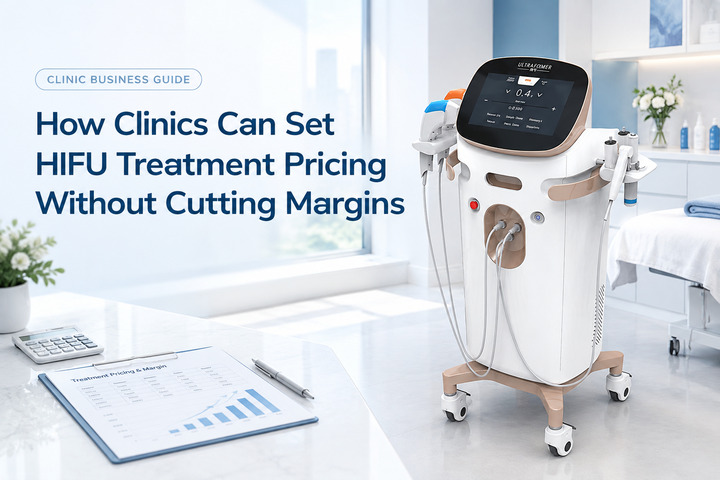

Stop Pricing HIFU by Competitor Price
Looking at local competitors is useful, but it should be a market reference, not your pricing formula. Two clinics can charge very different prices for what looks like the same HIFU service and still both be profitable.
The Cheapest Price Is Not the Benchmark
A competitor may have a different rent, staffing model, machine cost, treatment protocol, or client mix, so copying their price tells you very little about your own margin. The more useful question is not “What are they charging?” but “What does this treatment need to earn in my clinic?”
Start With Your Own Numbers
Before putting HIFU on your treatment menu, calculate the direct cost of delivering one session and the amount of staff and room time it consumes. This gives you a floor below which you should not casually discount.
Price for the Business You Want
A clinic focused on high client volume may use a different HIFU pricing model from a boutique aesthetic clinic offering longer consultations and more personalized treatment plans. Your price should support the kind of client experience, staffing level, and treatment capacity you actually want.
Know What One HIFU Treatment Really Costs
The machine purchase is only the visible part of the investment. The treatment-level economics are where clinic owners often discover that their “high-margin” service is not quite as high-margin as expected.
Count More Than the Machine
Your treatment cost can include machine depreciation, cartridge usage, staff wages, room time, utilities, marketing allocation, payment fees, maintenance, and other operating costs. You do not need to assign every overhead expense perfectly, but ignoring the major ones can make your HIFU ROI look better than it really is.
Calculate Cost Per Treatment
For a practical working model, start with direct consumables and labor, then add a reasonable share of equipment and operating costs. The goal is not accounting perfection; it is having a number that helps you decide whether a $500, $800, or $1,200 treatment makes business sense.
Include Staff and Room Time
A treatment that takes 90 minutes is not economically identical to one that takes 45 minutes, even when the machine and cartridge cost are the same. Your room and staff can only be used once at a time, so idle capacity and treatment duration deserve a place in your HIFU pricing calculation.
A Practical HIFU Treatment Cost Model
| Cost Factor | What to Calculate | Why It Matters |
|---|---|---|
| Machine cost | Cost allocated per treatment | Covers equipment investment |
| Cartridge | Actual shots used × cartridge cost | Tracks consumable economics |
| Staff time | Hours × loaded labor cost | Captures real labor |
| Room time | Treatment hours × room cost | Accounts for space utilization |
| Payment / admin | Fees and booking costs | Prevents small costs from adding up |
| Maintenance | Monthly estimate per treatment | Helps plan long-term ownership |
| Total treatment cost | Sum of the above | Your working cost baseline |
Price by Treatment Hour, Not Just Session
This is one of the most useful numbers for a clinic owner and one of the least discussed in generic HIFU pricing guides. A treatment can have a healthy price per session and still underperform if it occupies your room and staff for too long.
Calculate Revenue Per Hour
Use a simple formula:
Revenue Per Treatment Hour = Treatment Price ÷ Total Treatment Time
For example, a $600 treatment taking 60 minutes generates $600 per treatment hour, while a $900 treatment taking 90 minutes also generates $600 per treatment hour before costs.
Why Treatment Time Changes Pricing
Suppose two HIFU treatments both sell for $800, but one takes 60 minutes and the other takes 100 minutes. The first leaves much more room in your schedule for additional appointments, which can change the economics of the entire treatment menu.
Compare Short and Long Sessions
Use the same calculation for different treatment options rather than assuming the higher-ticket service is automatically better.
| HIFU Treatment | Price | Treatment Time | Revenue / Treatment Hour |
|---|---|---|---|
| Targeted Area | $450 | 40 min | $675/hour |
| Full Face | $700 | 60 min | $700/hour |
| Face + Neck | $950 | 90 min | $633/hour |
| Extended Program | $1,200 | 120 min | $600/hour |
Planning example only: actual pricing, treatment time, and protocol should be based on your own market, machine, staff, and treatment method.
The Number Your Menu Often Hides
A price list tells you what the client pays, but it does not tell you what the room earns. Revenue per treatment hour gives you a much better way to compare HIFU with facial treatments, laser services, body treatments, or other services competing for the same treatment room.
Stop Selling HIFU by Shot Count Alone
Shot count matters for treatment planning and cartridge economics, but it should not become the entire customer-facing pricing strategy. Clients generally care more about what area is being treated, what the appointment includes, and what the plan is trying to achieve.
More Shots Do Not Always Mean More Value
A higher shot count can mean higher consumable usage, but it does not automatically mean the treatment is more valuable to the client. Pricing should reflect the overall service and protocol rather than turning every consultation into a discussion about numbers.
Package the Treatment Around Goals
Instead of creating a menu with ten different shot-count options, organize treatments around clear client needs such as targeted lifting, full-face treatment, face and neck programs, or maintenance. Internally, your team can still monitor shot usage to control costs.
Explain What the Client Is Paying For
The client is paying for more than the cartridge: consultation, treatment planning, professional operation, room time, aftercare, follow-up, and the overall service experience all contribute to the price. This is especially important when your clinic is positioned above the low-cost segment.
A Better Way to Present HIFU
| Instead of Selling | Consider Presenting |
|---|---|
| 300 shots | Targeted lifting treatment |
| 500 shots | Full-face treatment |
| 700 shots | Face + neck treatment |
| Extra 100 shots | Optional treatment area |
| “Maximum shots” | Customized treatment plan |
Make Your HIFU Price Match the Client
There is no single “correct” HIFU price because clinics are selling into different markets. The same treatment can feel expensive, reasonable, or surprisingly cheap depending on what the client expects from the experience.
Entry Clients Need Less Friction
A new client may be more comfortable trying a clearly defined smaller-area treatment before committing to a premium program. This gives you an entry point without forcing the whole menu to compete at a low price.
Core Clients Need Clear Value
Your main HIFU treatment should be the easiest option for staff to explain and for clients to understand. A strong core treatment can anchor the menu, while smaller and larger options make the overall pricing feel more intentional.
Premium Clients Buy More Than Shots
Higher-value clients are often paying for customization, practitioner expertise, consultation quality, privacy, convenience, follow-up, and confidence in the process. That gives a clinic room to compete on experience and professionalism rather than simply lowering the price.
Match the Menu to Your Positioning
| Clinic Positioning | Pricing Focus | Client Message |
|---|---|---|
| Value-oriented | Efficient treatment | Simple and accessible |
| Mainstream professional | Clear treatment value | Reliable and structured |
| Premium aesthetic | Customization + experience | Personalized treatment plan |
| High-end medical aesthetic | Expertise + documentation | Advanced professional service |
Build a HIFU Treatment Menu That Makes Sense
A good HIFU menu should make the buying decision easier, not turn it into a spreadsheet exercise. Keep a clear core service and use areas, upgrades, and maintenance options to create logical steps.
Start With One Core Treatment
Choose one treatment that most staff can explain in a sentence or two and make that your menu anchor. Too many HIFU variations at launch often create internal confusion before they create more sales.
Add Areas Instead of Random Discounts
It is usually cleaner to add neck, jawline, or another defined treatment area than to keep lowering the price of the main session. Clients can understand “add an area” much more easily than a series of arbitrary 10% or 15% discounts.
Create Upgrade Paths Carefully
A smaller treatment can act as an entry point, while a broader treatment gives the client a natural upgrade. The key is to make each option meaningfully different rather than creating three nearly identical services with slightly different prices.
Example Menu Structure
| Menu Level | Example Service | Role |
|---|---|---|
| Entry | Targeted HIFU | Lower-friction introduction |
| Core | Full-Face HIFU | Main revenue service |
| Upgrade | Face + Neck HIFU | Higher-ticket option |
| Premium | Customized HIFU Program | Personalized treatment plan |
| Maintenance | Follow-Up HIFU | Long-term client care |
Use Packages Without Starting a Price War
Packages can improve planning and rebooking, but a package should not simply mean “buy three and get the biggest discount.” The strongest packages make the treatment journey easier to understand and easier to follow.
Sell the Plan, Not the Discount
A package has more value when it explains what happens next, when follow-up takes place, and what the client is monitoring. This changes the conversation from “How much do I save?” to “What is the plan?”
Make the Second Visit Easier to Book
Instead of waiting for the client to decide later, make the follow-up part of the original treatment journey. This can improve schedule planning and reduce the number of clients who disappear after the first session.
Protect Your Margin on Bundles
Calculate package profitability using the actual average consumable usage and staff time rather than multiplying the single-session price by three. A discount is only useful when the resulting treatment volume still leaves enough contribution for the clinic.
Compare Single and Package Economics
| Option | Client Pays | Treatments | Effective Price / Treatment | Margin Check |
|---|---|---|---|---|
| Single | $700 | 1 | $700 | Baseline |
| 3-Treatment Plan | $1,950 | 3 | $650 | Check total usage |
| Premium Program | $2,400 | 3 | $800* | Includes added service value |
*Example only. Premium pricing should reflect the additional consultation, services, products, follow-up, or other value actually included.
Know When Your HIFU Price Is Too Low
A low price is not automatically a smart entry strategy. Sometimes the warning sign is not a lack of bookings but the opposite: the clinic is busy while the business is struggling to create enough profit from the room and staff time.
Busy but Not Profitable
If your HIFU schedule is full but your contribution per treatment hour is weak, adding more bookings will not necessarily solve the problem. Review treatment time, cartridge usage, discounting, and staff capacity before deciding you simply need more clients.
Too Many Discounts
Frequent discounts make the standard price harder to believe and can train existing clients to wait for promotions. A clearer menu with logical packages usually gives you more pricing control than constantly changing the sticker price.
No Room for Follow-Up
A treatment price that leaves no room for proper consultation, aftercare, or follow-up can create a false sense of margin. Your price should support the complete client journey, not just the machine time.
Know When Your HIFU Price Is Too High
A premium price is not a problem by itself, but the clinic needs to give clients a clear reason to understand it. When the price and perceived value are disconnected, staff end up defending the number instead of explaining the treatment.
Clients Ask About Price Too Early
If the first question after hearing the treatment name is always “How much?”, the issue may be unclear positioning rather than simply price. Review how the service is presented, what the consultation includes, and whether the menu gives clients enough context before the price appears.
Staff Struggle to Explain the Value
A price is difficult to defend when every staff member describes the treatment differently. Give the team a simple explanation covering who the treatment is for, what the appointment includes, how it fits into the treatment plan, and what follow-up looks like.
Your Treatment Menu Has No Entry Point
A high-ticket flagship treatment can work well, but some clinics make it harder than necessary for first-time clients to enter the category. A smaller, clearly defined option can let clients experience the service without forcing you to lower the price of your core treatment.
Use Results to Support Your HIFU Pricing
One of the strongest ways to protect pricing is to make the treatment journey more measurable and easier for clients to understand. This does not mean promising guaranteed outcomes; it means documenting the process professionally.
Set a Clear Starting Point
Record the treatment area, relevant client goals, and appropriate baseline information before the first session. This gives both the client and staff a clearer reference for future consultations.
Track Progress Over Time
Follow-up photos, treatment records, and suitable progress assessments can make later conversations more concrete. Keep the comparison consistent and avoid presenting cosmetic observations as guaranteed medical outcomes.
Turn Follow-Up Into Part of the Value
A well-planned follow-up can help the client understand what happened, what should happen next, and whether the treatment plan needs adjusting. That makes it easier to position your HIFU service as an ongoing professional program rather than a one-off machine session.
What to Track After Launching a New HIFU Treatment
Do not wait until the end of the year to decide whether your HIFU pricing works. A small monthly dashboard can show where the economics are actually going wrong.
Average Revenue Per Session
Track the actual amount clients pay rather than the menu price. This reveals how much discounting, package sales, and upgrades are changing your real average ticket.
Revenue Per Treatment Hour
This is one of the most useful operational numbers because it puts HIFU on the same scale as your other treatments. It helps you compare services competing for the same room and staff capacity.
Consumable Cost Per Client
Record actual cartridge usage rather than relying on the rated shot count. Your business model should be based on how your clinic uses the consumable in practice.
Booking and Rebooking Rate
A profitable treatment is not only about the first appointment. Rebooking behavior, package completion, and follow-up activity tell you whether the service can support a longer client relationship.
First-Month HIFU Dashboard
| Metric | Formula / Method | Why Track It |
|---|---|---|
| Average treatment price | Total HIFU revenue ÷ sessions | Shows real selling price |
| Revenue / treatment hour | Treatment revenue ÷ treatment hours | Measures room productivity |
| Cartridge cost / client | Actual consumable use × cost | Protects margin |
| Staff cost / treatment | Treatment time × labor rate | Captures labor |
| Package rate | Package clients ÷ HIFU clients | Measures plan adoption |
| Rebooking rate | Rebooked clients ÷ eligible clients | Shows repeat potential |
| Discount rate | Discounts ÷ menu value | Detects price leakage |
A Simple HIFU Pricing Formula
You do not need a complicated financial model to create a workable starting price. What matters is knowing your minimum economics and then deciding how much additional value your positioning and treatment model can support.
Calculate Your Minimum Price
Start by adding the direct costs of delivering the treatment and a reasonable contribution toward equipment and operating expenses. This gives you a practical minimum price for decision-making.
Minimum Sustainable Price = Consumables + Staff Cost + Room Cost + Equipment Allocation + Other Direct Costs
Add Your Target Margin
Once you know the minimum sustainable price, add the contribution you need to make the service worthwhile for the business. Do not confuse a healthy selling price with a healthy margin; the latter only becomes clear after you account for your actual costs.
Target Treatment Price = Total Treatment Cost + Required Contribution
Test the Price With Real Clients
A spreadsheet can tell you whether a price works mathematically, but client behavior tells you whether the market accepts it. Test the price, monitor objections and booking behavior, and review your numbers after you have enough real appointments to see a pattern.
A Better Pricing Decision Tree
1. Know Your Cost
Consumables, staff, room and equipment allocation
2. Measure Capacity
Treatment time and revenue per treatment hour
3. Set the Floor
Identify the minimum sustainable treatment price
4. Match Positioning
Align the menu with your target client
5. Test in Practice
Watch booking, objections and package behavior
6. Review Regularly
Adjust when costs, demand or positioning change
The point is not to find a perfect number on day one. It is to build a pricing system that can be tested and improved without immediately resorting to discounts.
Common HIFU Pricing Mistakes to Avoid
The most expensive pricing mistakes are often not dramatic. They are small decisions repeated over months—slightly too much discounting, slightly too many shots, or slightly too much treatment time for the price being charged.
Copying the Cheapest Clinic
A competitor's low price may be based on a completely different cost structure or positioning. Use competitors to understand the market, but use your own treatment economics to determine your floor.
Discounting Before Testing
New clinics sometimes launch with a permanent “introductory” price that becomes difficult to remove later. Test your standard price and use targeted launch offers only when you know what behavior you are trying to encourage.
Ignoring Cartridge Economics
A cartridge may have a large rated shot count, but that does not mean every treatment will use the same number of shots. Track actual usage so your HIFU machine ROI model reflects how the device is being used in your clinic.
Creating Too Many Treatment Options
A menu with too many similar HIFU services makes both pricing and staff training harder. Start with a clear core offer and add options only when there is a genuine client or operational reason.
Promising Results to Justify Price
A high treatment price should not depend on unrealistic promises. Stronger positioning comes from a professional process, appropriate client selection, clear communication, consistent documentation, and sensible follow-up.
What Experienced Clinic Owners Look At Before Setting Price
The biggest pricing decisions happen before the treatment goes live. Experienced operators look beyond the machine and ask whether the treatment can fit their actual schedule, staff, client base, and service strategy.
Treatment Time
Know how long the complete appointment takes, not just the energy delivery or machine operation time. Preparation, consultation, photography, cleaning, documentation, and turnover all affect your real capacity.
Consumable Usage
The cost of each HIFU treatment depends on actual cartridge consumption, not just the purchase price of the machine. Track how many shots your chosen protocol typically uses and build that into your pricing model.
Staff Skill Level
A new operator may need more training time and supervision than an experienced practitioner. Pricing should reflect your real operating model, and supplier training can be an important part of reducing the learning curve.
Local Client Positioning
Look at the type of client you want to attract rather than simply the average price in your city. A clinic serving a premium audience may need a different treatment presentation and service structure from a high-volume beauty salon.
Follow-Up Potential
Ask what happens after the first treatment. A HIFU service with a sensible follow-up pathway can have greater long-term value than a one-off appointment, especially when your team documents the client journey properly.
Before You Launch: A Pricing Reality Check
| Question | Green Light | Warning Sign |
|---|---|---|
| Do you know your treatment cost? | Yes | Based on guesswork |
| Do you know revenue per treatment hour? | Yes | Only watching session price |
| Do you track actual shots used? | Yes | Using rated shots blindly |
| Can staff explain the service consistently? | Yes | Different answers from each staff member |
| Is there a clear core treatment? | Yes | Too many similar options |
| Is follow-up built into the journey? | Yes | Client leaves with no next step |
| Can the price survive normal discounts? | Yes | Margin disappears immediately |
FAQ
These are practical questions clinic and spa owners often ask when adding a new HIFU treatment to their service menu.
How much should I charge for HIFU treatment?
There is no single price that works for every clinic because local demand, treatment time, machine cost, consumables, staff costs, and positioning are different. Start with your own cost and revenue-per-hour model, then compare the result with your local market.
How do I calculate the cost of a HIFU treatment?
Add the consumable cost, staff time, room time, equipment allocation, and other direct operating costs associated with the treatment. The exact formula can vary, but the important thing is to use your real treatment workflow rather than only the machine purchase price.
How many HIFU shots should I charge for?
For most clients, it is easier to structure the menu around treatment areas or treatment programs rather than selling individual shots. Internally, however, tracking actual shot usage is important because it directly affects your cartridge economics and HIFU treatment margin.
Should HIFU pricing be based on area or shots?
Either can work, but area-based or treatment-based pricing is usually easier for clients to understand. Shot usage is still useful internally for controlling cost and ensuring that your pricing reflects how the treatment is actually delivered.
Is HIFU treatment better priced as a package?
Packages can work well when they represent a clear treatment plan rather than simply a discount. Before offering one, calculate the total consumable usage, staff time, and follow-up requirements across the full package.
How can I make HIFU more profitable?
Start by improving the economics of each treatment rather than simply trying to sell more sessions. Review price, treatment time, shot usage, staff efficiency, room utilization, package structure, and rebooking together.
How much does a HIFU machine cost to operate?
Operating cost depends on the machine, cartridge consumption, treatment protocol, staff time, maintenance, and how frequently the device is used. A useful approach is to calculate the cost per treatment and then evaluate it against revenue per treatment hour.
How do I price HIFU without competing on price?
Build the price from your own treatment economics and make the client understand what the service includes. A clearly defined treatment plan, professional consultation, appropriate follow-up, and consistent client experience give you more ways to compete than simply being the cheapest clinic.
Ready to Build a More Profitable HIFU Treatment?
A profitable HIFU service is not created by choosing the highest price in the market. It comes from understanding what each treatment actually costs, how much capacity it consumes, who it is designed for, and how the first appointment connects to the next one.
Start With Your Treatment Economics
Before launching a new HIFU treatment, calculate your cartridge cost, staff time, room time, treatment duration, revenue per treatment hour, and expected follow-up. Once those numbers are clear, pricing becomes a business decision instead of a guess based on a competitor's menu.
Choose the Right HIFU Setup With Krysmed
Krysmed supports clinics and aesthetic businesses with professional HIFU systems, training, and technical support. When comparing a HIFU machine, look beyond the purchase price and consider cartridge economics, treatment workflow, training, service support, and how the system fits the treatment model you want to build.
Ready to Build a Better HIFU Pricing Model?
Talk to Krysmed about your planned treatment menu, expected treatment volume, cartridge usage, and business positioning to evaluate the right HIFU setup for your clinic. Contact Krysmed now!
 WhatsApp
 info@krysmed.com
 +86 19867944875