

News
16
Aug
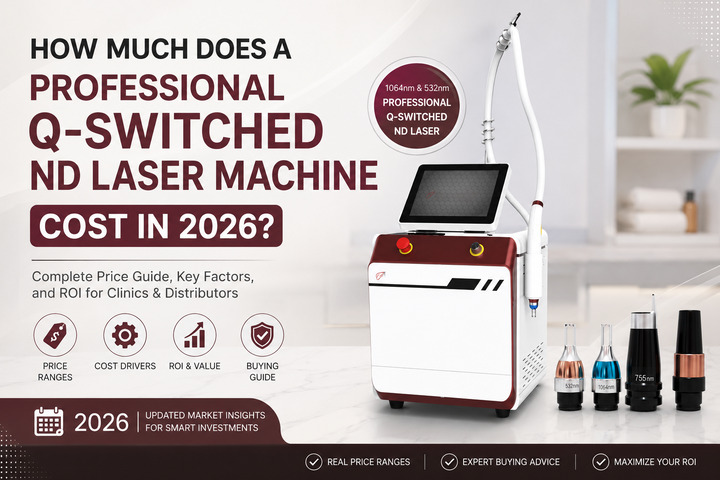
How Much Does a Professional Q-Switched Nd Laser Machine Cost in 2026?
If you've Googled "how much does a Q-Switched Nd:YAG laser machine cost," you've probably seen quotes ranging from under $1,000 to over $20,000 — and felt more confused than before. The big question isn't simply why the prices are so different, but what you're actually getting at each price point and whether the machine is reliable enough for your clinic or distribution business. This guide breaks down the real cost factors, price ranges, and what to check before buying, so you can make a smarter investment instead of choosing a machine based on price alone.
How Much Does a Q-Switched Nd:YAG Laser Machine Cost in 2026?
In 2026, a professional Q-Switched Nd:YAG laser machine typically runs from about $1,500 for an entry-level unit to $20,000+ for a fully loaded premium system, with most serious clinic-grade machines landing between $4,000 and $9,000.
Typical Price Range for Entry-Level Machines
Entry-level Q-Switched Nd:YAG machines usually cost $1,500–$4,000 and suit startups or businesses adding basic tattoo-removal and pigmentation work. They get the job done, but expect simpler cooling, fewer handpieces, and shorter warranties than mid-range units.
Mid-Range Professional Q-Switched Nd:YAG Laser Machines
Mid-range systems priced around $4,000–$9,000 are the sweet spot for salons, med spas, and small clinics that plan to run treatments daily. You're paying for steadier energy output, better cooling, and the training and support that keep a busy schedule running without surprises.
Premium Q-Switched Nd:YAG Laser Systems
Premium machines at $9,000–$20,000+ bring higher-grade laser sources, multi-wavelength flexibility, and stronger brand or certification backing. Just remember that a higher price tag doesn't automatically mean better results for your specific treatments — match the machine to the work, not to the brochure.
Quick Price Comparison Table (2026)
Here's the market at a glance:
| Tier | Typical Price (USD) | Best For | What You Get |
|---|---|---|---|
| Entry-Level | $1,500–$4,000 | Startups, basic pigmentation/tattoo | Single/dual wavelength, basic cooling, shorter warranty |
| Mid-Range | $4,000–$9,000 | Salons, med spas, small clinics | Stable energy, better cooling, training included |
| Premium | $9,000–$20,000+ | High-volume clinics, distributors | Top laser source, multi-wavelength, full support |
Price distribution (2026):
Entry-Level   ████████░░░░░░░░░░  $1.5k-$4k
Mid-Range     ██████████████░░░░  $4k-$9k
Premium       ███████████████████  $9k-$20k+
Why Do Q-Switched Nd:YAG Laser Machine Prices Vary So Much?
The same "Q-Switched Nd:YAG" label can sit on machines with completely different internals, and that's where the real cost — and the real risk — lives.
Laser Source Quality
The laser source is the heart of the machine and the biggest factor in long-term stability and energy output. Don't shop by wattage alone; a quality source from a proven supplier outlasts a bigger number from a mystery brand.
1064 nm and 532 nm Wavelength Configuration (and 1320 nm)
Dual wavelengths (1064 nm for dark ink and deep pigment, 532 nm for red/orange and superficial spots) are the professional baseline, with 1320 nm added for skin rejuvenation. More wavelengths mean more treatable conditions, which is why a triple-wavelength unit costs more than a single-wavelength one — see this pigment & tattoo treatment guide for real-world use.
Energy Stability and Pulse Performance
Stable energy beats "maximum energy" every time, because inconsistent pulses mean uneven results and unhappy clients. Ask how the machine holds its output through a full day of back-to-back treatments — that's what protects your daily revenue.
Cooling System and Machine Construction
Cooling, internal optics, and the overall build decide how long a machine runs continuously before it overheats or breaks. A beefier cooling loop and solid construction cost more up front but save you from downtime during your busiest weeks.
Software, Safety Features and User Experience
Operation software, parameter presets, emergency stop, and system protection all add to the cost — and to your peace of mind. Good software also shortens staff training, which is money saved before you treat your first client.
| Factor | Why It Matters | What to Check |
|---|---|---|
| Laser source | Drives lifespan & output | Brand, warranty on the source |
| Wavelengths | Expands treatable conditions | 1064 / 532 / 1320 configuration |
| Energy stability | Protects results & revenue | Stability over a full day |
| Cooling / build | Reduces downtime | Cooling type, chassis quality |
| Software / safety | Easier, safer operation | Presets, emergency stop, protection |
Q-Switched vs Picosecond — Do You Really Need the Expensive Upgrade?
Picosecond machines are the newer, pricier cousins of Q-Switched Nd:YAG, so it's worth knowing which one your business actually needs before you pay the premium.
How Picosecond Differs from Q-Switched (in Plain Language)
A Q-Switched Nd:YAG fires in nanoseconds while a picosecond laser fires roughly 100x faster, shattering ink into finer particles. The faster pulse can mean fewer sessions for stubborn ink, but the technology and price are both a clear step up.
When Q-Switched Is Still the Smarter Buy in 2026
For most clinics doing standard tattoo removal, pigmentation, and carbon facials, a well-built Q-Switched Nd:YAG delivers the results clients want at a fraction of the cost. You can read the full Q-Switched vs Pico comparison to see where each wins.
When Picosecond Is Worth the Extra Cost
If you target dense, multi-color, or previously treated tattoos and high-end clients who expect the latest, picosecond earns its price through faster clearance. Just be sure your patient volume justifies the higher machine and consumable cost before upgrading.
Q-Switched Nd:YAG Laser Machine Price Comparison: What Are You Actually Paying For?
Putting price and configuration side by side is the fastest way to see why "cheap" and "expensive" are rarely the same machine in a different box.
Budget vs Professional vs Premium — Side-by-Side
| Factor | Budget | Professional | Premium |
|---|---|---|---|
| Machine price | $1.5k–$4k | $4k–$9k | $9k–$20k+ |
| Laser source | Standard | Proven, stable | Top-grade |
| Wavelengths | 1064 / 532 | 1064 / 532 (+1320) | Full multi |
| Cooling | Basic | Active, reliable | Heavy-duty |
| Software | Simple | Presets + safety | Advanced + branding |
| Warranty | 6–12 mo | 12–24 mo | 24 mo+ |
| Training | Minimal | Included | Included + custom |
| Technical support | Email only | Remote + parts | Priority |
Don't Compare Machines by Price Alone — Look at Total Cost of Ownership
The sticker price is only part of the story once you add shipping, import tax, installation, training, and after-sales. Compare total cost of ownership, not the FOB quote, and the "expensive" machine often turns out cheaper over three years.
What Is Included in the Price of a Professional Q-Switched Nd:YAG Laser Machine?
A low quote can look great until you realize the handpieces, training, and warranty are all sold separately, so always confirm what's in the box.
Standard Accessories
Most professional machines ship with the laser handpieces, protective eyewear, a foot pedal, and basic treatment tips. Confirm the count and type of handpieces, because replacements are where hidden costs quietly appear.
Training and Treatment Guidance
Good suppliers include operation training, starter treatment protocols, parameter guidance, and maintenance know-how — usually delivered as manuals, videos, and live sessions. Training is what turns a box of parts into a machine your team can actually run safely.
Warranty and Technical Support
Expect a warranty period, access to spare parts, remote troubleshooting, and clear support response times. A solid support package is worth more than a discount when a handpiece fails on a Saturday.
How Much Does a Q-Switched Nd:YAG Laser Machine Cost from a Chinese Manufacturer?
Buying from a China source factory like Krysmed changes the math because you skip distributor markups — but the real value is in configuration, support, and customization, not just a lower number.
Factory Direct vs Distributor Pricing
Each layer between the factory and your clinic adds margin, so factory-direct pricing is usually lower for the same spec. Still, don't equate "cheap" with "safe" — verify the factory is real before you commit.
OEM and Private Label Pricing
Logo, software branding, packaging, and custom configurations adjust the quote and are ideal for distributors and growing brands. A source factory's OEM/ODM program lets you build a machine that looks and feels like your own product.
What to Ask a Q-Switched Nd:YAG Laser Manufacturer Before Buying
Ask about the laser source, wavelengths, energy range, cooling system, certifications, warranty, training, spare parts, and after-sales before you sign. Those nine answers tell you more than any price sheet about what you're really buying — and at Krysmed they're exactly what we walk every new partner through before a quote.
For Distributors & Resellers: OEM Customization & Your Profit Margin
If you buy machines to sell them, the margin isn't only in the unit price — it's in how different your product looks from everyone else's.
MOQ, Logo and Interface-Language Customization — How to Negotiate
Minimum order quantities, logo placement, and interface language are all negotiable with a source factory, which lowers your entry barrier. Start with a small custom
batch to test your market before scaling.
How to Turn One Machine Into Your "Exclusive Selling Point"
Pair custom branding with bundled training and protocols so your machine solves a problem competitors don't. That package — not the hardware alone — is what lets you charge more and keep customers.
Is a More Expensive Q-Switched Nd:YAG Laser Machine Better?
A higher price only pays off when the machine matches your volume, your treatments, and your growth plans — not because it impresses on paper.
When a Budget Machine May Make Sense
A budget unit fits a startup, low treatment volume, basic pigmentation or tattoo work, and a tight opening budget. It gets you into the market and earning while you learn what your clients actually want.
When It's Worth Investing in a Professional System
Step up to a professional system when you have high patient flow, multiple treatment types, long-term plans, or a distributor business. The extra stability and support protect revenue you can't afford to lose during downtime.
How to Calculate the ROI of a Q-Switched Nd:YAG Laser Machine
Moving from "how much does it cost" to "how fast does it pay back" is the question that actually protects your investment.
Calculate Your Treatment Revenue
Multiply your per-treatment price by the number of treatments you expect each month. For example, 30 tattoo-removal sessions at $120 equals $3,600 in monthly treatment revenue.
Estimate Your Break-Even Point
Divide the machine cost by your profit per treatment to get the number of sessions needed to recover the investment. A $6,000 machine at $80 profit per session breaks even after roughly 75 treatments.
Don't Forget the Hidden Costs
Shipping, import tax, consumables, maintenance, marketing, training, and downtime all chip away at raw profit. Build them into your model so your real break-even is honest, not hopeful.
| Assumption | Value |
|---|---|
| Machine cost | $6,000 |
| Price per treatment | $120 |
| Treatments / month | 30 |
| Gross profit / month* | $3,600 |
| Break-even (months) | ~1.7 |
* before consumables and overhead
7 Questions to Ask Before Buying a Q-Switched Nd:YAG Laser Machine
Before any purchase, run your shortlist through these seven questions — they map directly to the manufacturer checklist above and expose weak machines fast.
What laser source does the machine use?
Does it include both 1064 nm and 532 nm wavelengths?
How stable is the energy output?
What cooling system does it use?
What certifications are available?
Is professional training included?
What happens if the machine needs technical support?
Q-Switched Nd:YAG Laser Machine Price: What Should Clinics Expect in 2026?
Clinics in 2026 should expect a wide but logical price spread where the right machine balances price, performance, reliability, and support rather than chasing the lowest tag — budget $4,000–$9,000 for a dependable workhorse, and treat training and warranty as part of the price, not an extra, which is exactly how we help partners at Krysmed.
Frequently Asked Questions About Q-Switched Nd:YAG Laser Machine Cost
Here are the questions clinic owners and distributors ask us most, answered straight from the factory floor.
How much does a professional Q-Switched Nd:YAG laser machine cost?
A professional unit typically costs $1,500–$20,000+, with most clinic-grade machines between $4,000 and $9,000. Your final price depends on wavelength config, laser source, cooling, and the support package.
What is the average price of a Q-Switched Nd:YAG laser machine in 2026?
The realistic average for a daily-use professional machine in 2026 is around $4,000–$9,000. Entry-level units start near $1,500, while premium multi-wavelength systems exceed $20,000.
Why are some Q-Switched Nd:YAG laser machines so cheap?
Very low prices usually mean a weaker laser source, minimal cooling, no training, and a short or absent warranty. They can work for light use but carry higher downtime and replacement risk.
Is a cheap Q-Switched Nd:YAG laser machine worth buying?
For a startup with low volume and basic treatments, a budget machine can be a sensible entry point. Just price the missing training, warranty, and spare parts before you call it a bargain.
What is the difference between Q-Switched and picosecond laser?
Q-Switched fires in nanoseconds and picosecond in picoseconds, with picosecond breaking ink slightly finer for stubborn cases. See the Q-Switched vs Pico guide for a full breakdown.
How much does a Q-Switched Nd:YAG laser machine cost from a Chinese manufacturer?
Factory-direct pricing from a China source factory is generally lower than branded or distributor pricing for the same spec, often in the $1,500–$12,000 range by configuration. The saving comes from skipping middle layers, not from cutting quality — verify the factory is real.
What is included in the price of a professional Q-Switched Nd:YAG laser machine?
Expect handpieces, protective eyewear, a foot pedal, treatment tips, training, a warranty, and technical support — though cheaper quotes often exclude training and longer warranties. Always confirm the included list in writing.
Do I need FDA or CE certification to use it in my country?
It depends on your market: the EU needs CE, the US needs FDA clearance, and many others accept CE or local equivalents. Buy from a manufacturer like Krysmed that supplies the certifications your target market requires.
How long does a Q-Switched Nd:YAG laser machine last?
A well-maintained machine with proper cooling and a quality laser source can serve a busy clinic for many years. The laser source's rated shot count and your upkeep habits are the main variables, so ask the manufacturer for the rated lifespan and the warranty on the source rather than assuming a fixed number.
How long does it take for a Q-Switched Nd:YAG laser machine to pay for itself?
Payback varies widely by treatment price, patient volume, and local market — some clinics break even within a few months, others take closer to a year, so build your own model from the break-even example above instead of trusting a rule of thumb. That example reaches roughly 1.7 months only under its stated assumptions of 30 sessions at $80 profit each.
What should I look for when comparing Q-Switched Nd:YAG laser machine prices?
Compare laser source, wavelengths, energy stability, cooling, certifications, warranty, training, and support — not the sticker price. The lowest quote with the weakest support is rarely the cheapest over three years.
Conclusion
There is no single price for a professional Q-Switched Nd:YAG laser machine in 2026 — the number follows the configuration, the laser source, and the support behind it. Buy for long-term value, stability, training, and warranty, and the machine pays you back instead of costing you later.
Ready to Find the Right Q-Switched Nd:YAG Laser Machine for Your Clinic?
Tell us your treatments, budget, and target market, and we'll match you to the right configuration and a real 2026 quotation — no pressure, just a practical plan. Reach out today and contact Krysmed to start the conversation.
About Krysmed Technology — 15 Years as a Source Factory
Krysmed Technology is a China-based source factory with 15 years building aesthetic lasers and devices for clinics and distributors in 90+ markets — we're the manufacturer, not a reseller, so our advice starts with your business, not our catalog.
What We Give You: Training + OEM + Strict Quality Control
Every Krysmed device ships with training, OEM/ODM customization, and ISO 13485–backed quality control, because your success is the only metric we care about. From software branding to spare parts, we build the package that helps you sell and treat with confidence.
Our Contact
Ready to Elevate Your Business with Krysmed?
Let’s discuss your needs and find the best solution for your business. Our experts are here to provide personalized recommendations tailored to your business needs.
-
Call For Inquiry
-
Send Us Email
info@krysmed.com
Get A Custom Quote Now!
We value your privacy and guarantee a prompt, professional reply.
 WhatsApp
 info@krysmed.com
 +86 19867944875