

News
15
Aug
Q-Switched Nd:YAG Laser vs Fractional CO₂ Laser: Which One Is Better for Your Clinic?
If you run a salon, clinic, or distribute aesthetic devices, you've probably asked the same question we hear every week: which is the better buy, a Q-Switched Nd:YAG laser or a fractional CO₂ laser? The honest answer is that both are proven professional laser systems, but they aren't in a "who's more advanced" contest — they solve different skin problems, work at different depths, and fit different treatment menus. In this guide we compare the Q-Switched Nd:YAG laser vs fractional CO₂ laser across technology, treatment applications, downtime, patient demand, clinic positioning, and business investment, so you can pick the one that actually fills your calendar.
Q-Switched Nd:YAG Laser vs Fractional CO₂ Laser at a Glance
Here's the side-by-side view before we break each part down.
Quick Comparison of the Two Laser Technologies
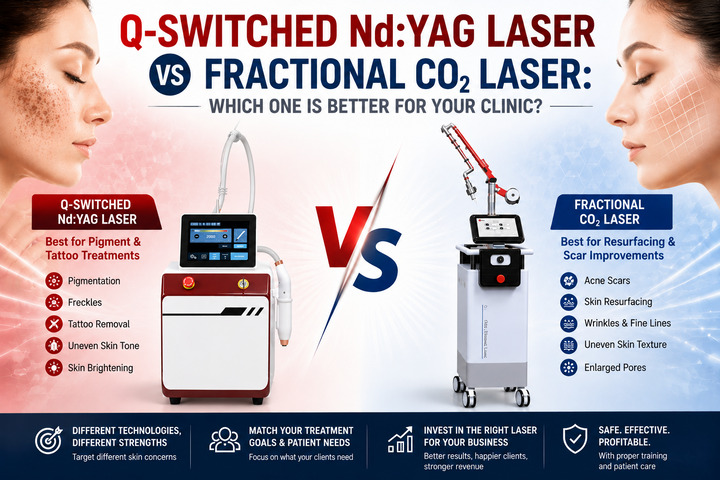
At a glance, the Q-Switched Nd:YAG laser is a pigment- and tattoo-focused system that works fast with little downtime, while the fractional CO₂ laser is a resurfacing system built for scars, texture, and wrinkles that needs more recovery. The quick-reference table lays out their principle, main goal, typical clinical use, treatment depth, surface effect, downtime, best-fit client, and menu role side by side.
| Dimension | Q-Switched Nd:YAG Laser | Fractional CO₂ Laser |
|---|---|---|
| Principle | Photoacoustic pigment shattering | Fractional ablative resurfacing |
| Main goal | Pigment, tattoo, toning | Scars, texture, wrinkles |
| Clinical use | Freckles, lentigines, tattoo, tone | Acne scars, pores, fine lines |
| Treatment depth | Epidermal–dermal pigment | Dermal remodeling columns |
| Surface action | Minimal, no controlled wound | Micro-wounds promoting rebuild |
| Downtime | Minimal–1 day | 3–7 days |
| Best-fit client | Busy clients wanting quick results | Clients wanting intensive correction |
| Menu role | High-volume pigment & tattoo | Premium resurfacing packages |
The Key Difference: Pigment Treatment vs Skin Resurfacing
The single most useful way to remember the difference is pigment treatment versus skin resurfacing: the Q-Switched Nd:YAG laser is built for color problems like spots and ink, while the fractional CO₂ laser is built to rebuild texture through controlled micro-injury. They're complementary, not competitors, so most clinics end up wanting both rather than picking a "winner."
How Does a Q-Switched Nd:YAG Laser Work?
Let's start with the machine most clinics meet first.
What Is Q-Switched Nd:YAG Laser Technology?
A Q-Switched Nd:YAG laser delivers ultra-short pulses that shatter pigment and tattoo ink into particles your body clears naturally, and it commonly runs at 1064 nm for deeper pigment and 532 nm for reds and superficial spots. Just remember that wavelength alone doesn't decide results — pulse characteristics, spot size, energy control, and your operator's technique matter as much as the number on the spec sheet.
What Skin Concerns Can a Q-Switched Nd YAG Laser Address?
In daily clinic work, a Q-Switched Nd:YAG laser is used for pigmentation, freckles, selected benign pigmented lesions, tattoo removal, uneven skin tone, and some skin-toning or rejuvenation sessions. It's a workhorse for any menu built around "clear, bright, even skin" with little downtime.
Why Clinics Choose Q-Switched Nd YAG Laser Machines
Clinics like it because one machine covers a wide range of pigment- and tattoo-related services, making it easy to build a pigment-focused treatment menu. For owners who want to add low-downtime laser revenue without heavy training overhead, that versatility is exactly what makes it attractive — not because it's a magic "all-in-one."
How Does a Fractional CO₂ Laser Work?
Now the heavier-duty resurfacing cousin.
What Is Fractional CO₂ Laser Resurfacing?
A fractional CO₂ laser places microscopic treatment columns into the skin to trigger collagen remodeling, which is why it's called "fractional" — it treats a fraction of the skin at a time rather than the whole surface. That's a big step up from older fully ablative resurfacing, because leaving untreated skin between columns speeds healing while still rebuilding texture.
What Skin Concerns Can Fractional CO₂ Laser Treat?
Fractional CO₂ laser treats acne scars, uneven skin texture, fine lines and wrinkles, enlarged pores, selected photodamage, and overall skin resurfacing and rejuvenation. It's the machine clinic owners reach for when clients want real structural improvement, not just a brightness boost.
Why Clinics Invest in Fractional CO₂ Laser Machines
Clinics invest in fractional CO₂ when they want to sell higher-value, intensive skin resurfacing rather than quick refresh treatments. The trade-off is real: you need solid operator training, careful patient selection, and a clear downtime-management plan before this machine pays off.
Q-Switched Nd:YAG vs Fractional CO₂: What's the Difference?
Here's where the two stop looking similar and start looking strategic.
Treatment Goals
The Q-Switched Nd:YAG laser aims at pigment-related problems and tattoo applications, while the fractional CO₂ laser aims at resurfacing, scars, texture, and wrinkles. Pick by the goal, not by which one sounds more "powerful."
Pigmentation vs Acne Scars
If most of your client questions are about pigmentation, lean toward the Q-Switched Nd:YAG laser; if they're about acne scars and uneven texture, the fractional CO₂ laser usually fits better. You can't choose correctly by asking "which laser is stronger" — you choose by what the skin actually needs.
Treatment Depth and Skin Resurfacing
Because fractional CO₂ creates controlled micro-wounds that remodel deeper tissue, it's generally the better tool for resurfacing-focused work, while the Q-Switched Nd:YAG laser stays the cleaner choice for pigment-focused applications. The difference comes from how each technology acts on skin tissue, not from a marketing claim.
Downtime and Patient Expectations
Across typical settings, fractional CO₂ needs more recovery and aftercare than the Q-Switched Nd:YAG laser, but the exact downtime depends on treatment parameters, skin condition, area, and the individual. Set client expectations honestly up front, because "how long will I be red" is the question that decides whether they book.
Treatment Versatility
The Q-Switched Nd:YAG laser brings pigment, tattoo, and selected rejuvenation services, while the fractional CO₂ laser brings resurfacing, acne scars, texture, and wrinkles. Instead of crowning one "more versatile," ask which kind of versatility matches the treatment menu you're actually trying to build.
Mini chart — recovery intensity (more bars = more downtime):
Q-Switched Nd:YAG: ██░░░ minimal–1 day
Fractional CO₂: █████ 3–7 days
| Comparison angle | Q-Switched Nd:YAG | Fractional CO₂ |
|---|---|---|
| Treatment goal | Pigment & tattoo | Resurfacing & scars |
| Best concern | Pigmentation | Acne scars / texture |
| Working depth | Epidermal–dermal | Dermal remodel |
| Downtime | Low | Higher |
| Versatility type | Broad, low-downtime | Intensive, premium |
Which Laser Is Better for Your Clinic?
Turn the theory into a buying decision with these checklists.
Choose a Q-Switched Nd YAG Laser If Your Clinic...
Buy a Q-Switched Nd:YAG laser if you regularly see pigmentation concerns, your clients prefer shorter or minimal downtime, you want to add tattoo removal, or you're building a pigment-focused laser menu on a versatile professional machine. It's the natural first laser for clinics that want broad appeal without a steep learning curve.
Choose a Fractional CO₂ Laser If Your Clinic...
Choose a fractional CO₂ laser if acne scars are a top client request, clients keep asking about skin resurfacing, or you want to grow texture and wrinkle treatments for clients who accept a real recovery period. Make sure your team already has laser treatment training and patient-management capability before committing.
When Buying Both May Make More Sense
For a mature clinic, running both often beats choosing one, because the Q-Switched Nd:YAG laser handles pigment-focused services while the fractional CO₂ laser handles resurfacing-focused services. They cover different categories, so they complement each other instead of competing for the same booking.
Q-Switched Nd:YAG vs Fractional CO₂: Which Is Better for Your Business?
The smartest purchase starts with your business, not the brochure.
Consider Your Most Common Patient Requests
Don't open the spec sheet first — open your appointment book and count how often clients ask about pigmentation, tattoo, acne scars, wrinkles, and texture. That demand tally tells you more about the right machine than any sales pitch.
Consider Treatment Pricing and Revenue Potential
A higher single-treatment price is only part of ROI; also weigh treatment frequency, patient demand, consumables, maintenance, training time, and operator hours. We won't promise a fixed ROI number, because your local market and menu shape the real return.
Consider Your Clinic's Existing Equipment
If you already run IPL, diode laser, RF microneedling, or other skin-rejuvenation devices, ask whether a new laser fills a gap or just adds another box. The goal is to add a service you don't already offer, not to collect machines.
Consider Training, Safety, and Local Regulations
Laser buying isn't just price and specifications — it's manufacturer training, technical support, device documentation, certification, and the rules in your country. Aesthetic laser operation, registration, and practitioner qualifications vary by market, so confirm what's required where you operate before you sign.
| Business factor | What to check |
|---|---|
| Patient requests | Count pigmentation / tattoo / scar / wrinkle demand |
| Revenue potential | Price × frequency − consumables − training time |
| Existing equipment | Does it fill a gap or duplicate? |
| Training & regulations | Local license, certification, operator qualification |
How to Choose a Professional Laser Machine Manufacturer
Once you know which laser you need, the harder question is who to buy it from.
Don't Compare Laser Machines by Wavelength Alone
Wavelength is only one slice of the picture; also compare pulse duration, energy control, spot size, cooling system, handpieces, and software controls. Two machines with the "same" wavelength can feel like different tools in your room.
Ask About Training and Technical Support
Before you buy, ask whether the supplier gives hands-on operator training, treatment protocols or parameter guidance, responsive after-sales support, and a steady supply of spare parts and consumables. A machine without training and parts is just an expensive paperweight — which is exactly why Krysmed builds operator training and OEM flexibility into every partnership.
Check Certifications and Documentation
Confirm the certifications and registration your target market actually requires, and don't lump CE, FDA, and other systems together as if they mean the same thing. Always verify the certificate covers the exact model you're buying, not just the manufacturer's homepage.
Look Beyond the Machine Price
The real cost includes shipping, warranty, training, technical support, replacement parts, consumables, and long-term serviceability — not just the sticker price. Build the full ownership picture before you compare quotes, or the cheap unit wins and the expensive surprises follow.
| True cost of ownership | Included? |
|---|---|
| Machine price | Base |
| Shipping & warranty | Often separate |
| Training & protocols | Varies by supplier |
| Spare parts & consumables | Ongoing |
| Long-term serviceability | Decides real ROI |
Q-Switched Nd:YAG or Fractional CO₂: Which One Should You Buy?
If you want the short version, here it is.
Choose Q-Switched Nd YAG for Pigment-Focused Services
Pick the Q-Switched Nd:YAG laser when your demand centers on pigmentation, freckles, and tattoo-related applications and you want to grow a pigment-focused treatment menu. It's the lower-downtime, higher-frequency engine for that side of the business.
Choose Fractional CO₂ for Resurfacing-Focused Services
Pick the fractional CO₂ laser when clients want acne scars, skin texture, wrinkles, and resurfacing, and you're ready to develop intensive skin-rejuvenation services. It carries more downtime and training weight, but it sits at the premium end of your menu.
Choose Both for a Broader Treatment Menu
For clinics with steady client flow, running both lets you cover pigment and resurfacing without turning clients away. The final call should rest on patient demand, clinical capability, budget, and business model — not on which demo looked flashier.
FAQ
The questions clinic owners and distributors ask us most, answered plainly.
| Question | Answer |
|---|---|
| Is Q-Switched Nd:YAG better than Fractional CO₂? | No universal "better" — it depends on the treatment goal, because pigment-focused and resurfacing-focused services are different jobs. |
| Can a Q-Switched Nd:YAG laser treat acne scars? | It helps with acne pigment, but true scar/texture correction is usually the job of a fractional CO₂ laser, not Nd:YAG. |
| Is Fractional CO₂ laser good for pigmentation? | Its main strength is resurfacing, so it isn't the first choice for every pigmentation concern; the plan depends on the specific issue. |
| Which laser has more downtime? | Generally fractional CO₂, due to its resurfacing nature; exact days vary with parameters, skin, area, and the individual. |
| Which laser is better for a small aesthetic clinic? | Follow your clients, budget, training capacity, and menu — many small clinics start with Nd:YAG, then add CO₂. |
| Can a clinic use both lasers? | Yes, and many do; they diversify your menu and serve different patient needs instead of overlapping. |
| What to look for in a Q-Switched Nd:YAG machine? | Wavelength, pulse control, energy, spot size, cooling, handpieces, software, certification, training, warranty, support. |
| What to look for in a Fractional CO₂ machine? | Scanning system, power/energy control, patterns, handpieces, cooling, precision, safety features, training, after-sales. |
Is Q-Switched Nd YAG better than Fractional CO₂?
There's no universal "better" — it depends on the treatment goal, because pigment-focused services and resurfacing-focused services are different jobs. Choose based on what your clients actually want treated.
Can a Q-Switched Nd YAG Laser treat acne scars?
It can help with pigment left by acne, but true scar and texture correction is usually the job of a fractional CO₂ laser, not a Q-Switched Nd:YAG laser. Match the machine to the problem: color versus structure.
Is Fractional CO₂ Laser good for pigmentation?
Fractional CO₂ laser's main strength is resurfacing, so it isn't the first choice for every pigmentation concern, especially where risk runs higher. The right plan depends on the specific skin issue and a proper professional assessment.
Which laser has more downtime, Q-Switched Nd YAG or Fractional CO₂?
Generally the fractional CO₂ laser involves more recovery because of its resurfacing nature, while the Q-Switched Nd:YAG laser is closer to no-downtime. We avoid quoting fixed days, since downtime shifts with parameters, skin condition, area, and the individual.
Which laser is better for a small aesthetic clinic?
For a small clinic, the better choice follows your clients, budget, training capacity, and current menu — not a one-size rule. Many small clinics start with the Q-Switched Nd:YAG laser for its lower cost and downtime, then add CO₂ as demand grows.
Can a clinic use both Q-Switched Nd YAG and Fractional CO₂ lasers?
Yes, and many do, because the two diversify your treatment menu and serve different patient needs rather than overlap. One handles pigment and tattoo, the other handles resurfacing and scars.
What should I look for when buying a Q-Switched Nd YAG laser machine?
Look at wavelength options, pulse control, energy adjustment, spot size, cooling, handpieces, software, certification, training, warranty, and technical support — not just price. A complete package matters more than a single headline number.
What should I look for when buying a Fractional CO₂ laser machine?
Prioritize the fractional scanning system, power and energy control, scanning patterns, handpiece options, cooling, treatment precision, safety features, and solid training with after-sales support. These details decide whether your resurfacing results are consistent and safe.
Final Takeaway
If you remember nothing else, remember this.
The Best Laser Depends on the Problem You Want to Solve
There is no overall "winner" between the Q-Switched Nd:YAG laser and the fractional CO₂ laser — only a better fit for your patient demand, treatment goals, and business model. The useful comparison isn't which is stronger, but which technology matches what your clinic is actually trying to do.
A Practical Rule for Clinic Owners
Use this simple rule: pigmentation or tattoo-focused demand points to the Q-Switched Nd:YAG laser, acne scars or resurfacing or texture points to the fractional CO₂ laser, and a broader treatment menu points to both. Write it on a sticky note above your intake form.
What to Do Before You Buy
Before you buy, define your target clients, analyze existing treatment demand, compare specs to real applications, verify certification and local rules, and confirm training, warranty, and technical support — then weigh machine price against expected business value. That order keeps you from falling in love with a demo and regretting the invoice.
Ready to Choose the Right Laser for Your Clinic?
At Krysmed, we help clinics and aesthetic businesses compare laser technologies based on treatment applications, machine specifications, target patients, and business needs—not just the price tag. If you're deciding between a Q-Switched Nd:YAG laserand Fractional CO₂ laser, contact Krysmed to discuss which solution makes more sense for your clinic.
Our Contact
Ready to Elevate Your Business with Krysmed?
Let’s discuss your needs and find the best solution for your business. Our experts are here to provide personalized recommendations tailored to your business needs.
-
Call For Inquiry
-
Send Us Email
info@krysmed.com
Get A Custom Quote Now!
We value your privacy and guarantee a prompt, professional reply.
 WhatsApp
 info@krysmed.com
 +86 19867944875