

News

03
Sep
How to Create a Profitable Aesthetic Treatment Menu for Your Clinic
The Short Answer: A profitable aesthetic treatment menu is not a list of every machine you own. It is four levels working together — Entry to bring people in, Core to carry revenue, Premium to lift ticket size, and Maintenance to bring clients back — organized around client concerns, priced on real costs, and tracked by one number many clinics overlook: revenue per treatment-hour.
All figures in this article are planning examples for illustration, not industry benchmarks. Your equipment costs, staffing, treatment prices, utilization, and local market will be different, so use the framework to run your own numbers.
What Makes a Menu Profitable
Most clinics think of a treatment menu as a price list. In practice, it is much closer to a business plan that your clients can see.
Start With Client Needs
Build the menu around the problems people actually walk in with, not the machines you recently purchased. Start by listing the three to five concerns you hear most often in consultations, then build services around those needs.
Balance Demand, Price, and Time
A treatment can be popular, high-priced, or fast, but the strongest menu items need to make sense across demand, pricing, and treatment time. A $100 service that books the room consistently can contribute more to the business than a $500 treatment that rarely gets booked.
Give Clients a Next Step
Every treatment should have a logical next step where appropriate: another session, a more comprehensive treatment plan, or ongoing maintenance. When the menu answers “what should I do next?”, you have a better chance of turning one appointment into a longer client relationship.
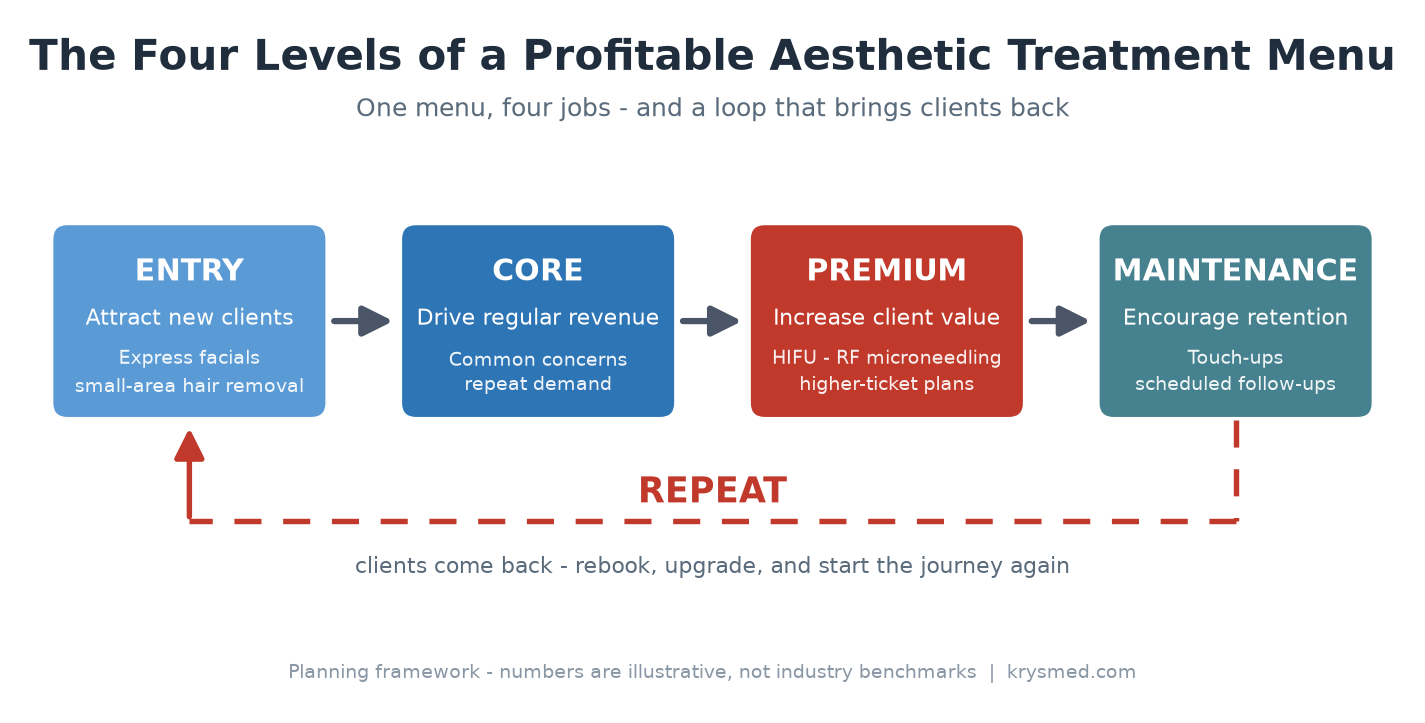
The Four Levels of a Profitable Menu
A simple four-level structure makes a treatment menu easier to manage and easier for clients to understand. Each level has a different job, so you do not need every treatment to perform in the same way.
Entry Treatments
Entry treatments are relatively easy to understand, try, and book, such as express facials or small-area hair removal. Their main job is to reduce the barrier for first-time clients and give people a reason to experience your clinic.
Core Treatments
Core treatments are the services that should generate a large share of regular revenue. They typically target common client concerns, have repeat demand, and can be delivered consistently by a trained team.
Premium Treatments
Premium treatments sit at the higher end of your menu and may involve more advanced technology, longer treatment plans, or greater client commitment. Examples can include HIFU, RF microneedling, advanced skin rejuvenation, or other higher-value services appropriate to your market and professional scope.
Maintenance Treatments
Maintenance treatments create the repeat-visit layer of the business. Depending on the service, this could mean periodic skin treatments, laser hair removal touch-ups, or scheduled follow-up treatments that support an ongoing client plan.
How the Four Levels Connect
Think of the four levels as a customer journey rather than four separate categories. A client may enter through a lower-barrier service, move into a core treatment, consider a premium plan, and eventually return for maintenance.
Entry → Core → Premium → Maintenance → Repeat
| Level | Main Job | Typical Booking Behavior |
|---|---|---|
| Entry | Attract new clients | Easy first purchase |
| Core | Drive regular revenue | Frequent bookings |
| Premium | Increase client value | Higher-ticket decisions |
| Maintenance | Encourage retention | Recurring visits |
Build Around Client Concerns
Clients usually do not walk into a clinic thinking about wavelengths, cartridges, or RF frequencies. They come in saying things like “my skin looks dull,” “I want to reduce hair,” or “I want firmer-looking skin,” so your menu should speak their language.
Skin Rejuvenation
Skin rejuvenation is a broad category covering concerns such as dull-looking skin, uneven texture, and visible signs of aging. Depending on your market and scope of practice, services may include facials, IPL-based treatments, RF treatments, or other skin-focused technologies.
Acne and Skin Texture
Active acne and post-acne texture are different concerns and should not automatically be sold as the same treatment. A clear menu can separate acne-focused services from treatments designed to improve the appearance of uneven texture or acne-related scarring.
Pigmentation
Pigmentation is another category where client expectations need to be managed carefully because different types of pigmentation may require different approaches. IPL, laser toning, and other technologies may be positioned for appropriate pigmentation concerns, but treatment suitability should always be assessed professionally.
Hair Removal
Laser hair removal is a natural entry-to-core service because clients often need a series of sessions rather than one appointment. That repeat nature also makes it well suited to treatment packages and scheduled follow-ups.
Skin Tightening
Skin tightening can sit toward the premium end of an aesthetic treatment menu depending on the technology, treatment area, positioning, and local market. HIFU and RF microneedling are examples of technologies that clinics may position around skin tightening and rejuvenation goals.
Body Contouring
Body contouring can attract clients looking for non-surgical aesthetic options for specific body concerns. Because treatment time, consumables, equipment requirements, and client expectations vary considerably, calculate the economics before adding a body treatment simply because competitors offer it.
Keep Names Simple
Clients are more likely to understand “Pigmentation Treatment” or “Skin Rejuvenation” than a menu filled with technical device names. Put the technology in the description or consultation materials and let the treatment name focus on the client's concern.
Fill Each Level
Once you know the concerns your market actually cares about, decide which services belong in each level. A focused menu is often easier to sell, train, schedule, and improve than a huge list of unrelated treatments.
Entry Level Picks
Choose services with a straightforward value proposition and relatively low commitment. Express facials, small-area laser hair removal, or other accessible services may work well here depending on your market.
Core Level Picks
Choose two or three services that match your area's strongest recurring demand and deliver them consistently. Depth usually matters more than variety at this level.
Premium Level Picks
Choose one or two premium services that your clinic can properly support with equipment, training, consultation, and staffing. One well-utilized premium service can be more useful than several expensive machines that rarely get booked.
Maintenance Level Picks
Maintenance services should follow naturally from your core and premium treatments. The easier it is for the client to understand when and why they should return, the easier it is for your team to rebook them.
Start Small
A new clinic does not need to launch with 30 different treatments. Starting with around 8–12 well-defined services can make operations and marketing more manageable, then you can expand based on actual booking data.
Choose the Right Equipment
Once the treatment menu is clear, equipment selection becomes much easier. The question changes from “Which machine should I buy?” to “Which equipment investment can help me deliver the treatments my market actually wants?”
Sell the Treatment First
Decide what treatment you want to offer before choosing the machine. Buying an aesthetic machine and then trying to create demand around it is a much riskier approach than validating the treatment opportunity first — for a worked example, see our guide to HIFU machine ROI.
One Machine, Many Uses
A well-chosen platform may support more than one commercially viable treatment, depending on its intended applications and local regulations. For a smaller clinic, better utilization of a few suitable machines can make more sense than filling every room with specialized equipment.
Count All Costs
The machine's purchase price is only the starting point. Include consumables, cartridges or handpieces where applicable, servicing, training, staff time, room usage, and other operating expenses when calculating your real treatment cost.
| Cost | What to Consider |
|---|---|
| Equipment | Initial investment and expected useful life |
| Consumables | Cost per treatment or session |
| Labor | Staff time required |
| Treatment Time | Room and appointment utilization |
| Maintenance | Service and replacement costs |
| Training | Initial and ongoing staff training |
| Marketing | Cost of generating bookings |
The key question is not simply “How much does the machine cost?” but “What does it cost me to deliver each treatment?”
Match Your Market
The right aesthetic machine depends on local demand, customer demographics, competition, pricing, and your clinic's positioning. A device that performs well for one clinic or country may not make financial sense for another.
Skip the Trend
A treatment being popular on social media does not guarantee local demand. Check consultation requests, customer questions, competitor offerings, existing bookings, and realistic pricing before making a major equipment investment.
Price for Profit
Pricing is where many treatment menus quietly lose money because the selling price gets attention while the actual delivery cost gets ignored. A profitable aesthetic treatment price needs to work for both the client and the clinic.
Know Your Real Cost
A simple starting point is:
Real Treatment Cost = Consumables + Labor + Allocated Operating Costs
For equipment-heavy treatments, you can also allocate part of the equipment investment across the number of treatments you realistically expect to perform rather than treating the machine as a hidden cost.
Build a Price Ladder
Your menu should have a clear relationship between entry, core, and premium pricing. The jump between levels should reflect a real difference in treatment scope, technology, session count, or client value.
Use an Anchor Item
A higher-priced premium service can provide context for the rest of the menu and make core services easier to compare. The anchor should represent a genuine service you are prepared to deliver, not an unrealistic price added simply to manipulate perception.
Give Clients Three Choices
Three clear options can be easier to compare than a long list of nearly identical packages. A Good → Better → Best structure can work particularly well when each option has a meaningful difference in sessions, treatment scope, or included services.
Avoid the Lowest-Price Trap
There will almost always be another clinic willing to charge less. Instead of trying to win every price-sensitive customer, compete on the value of the treatment, professional experience, consistency, technology, convenience, and overall client journey.
Packages for Repeat Revenue
Single sessions create transactions, while appropriate packages can create a longer treatment relationship. The important word is appropriate: do not package a treatment simply because a discount looks attractive.
Multi-Session Packages
If a treatment normally involves multiple sessions, presenting it as a structured treatment plan can make the process easier for both the client and the clinic. A package can also improve booking predictability when the pricing still leaves a healthy contribution margin.
Combine Treatments
Complementary services can sometimes be combined into a broader treatment plan when the combination is clinically and operationally appropriate. The strongest bundles follow the natural client journey rather than simply putting several unrelated treatments into one discount.
Good–Better–Best
Offer three levels such as Basic, Complete, and Comprehensive, with meaningful differences between them. The middle option can be positioned as the practical choice, but each option should still provide genuine value rather than existing purely to push clients toward the most expensive package.
Protect Your Margin
A package discount should not turn a profitable treatment into a low-margin service. Before publishing the offer, calculate the total treatment cost and expected contribution at the discounted package price.
Revenue per Treatment-Hour
Here is one number that deserves more attention: revenue per treatment-hour. It helps you compare services that have completely different prices and treatment times.
Why Per-Hour Wins
Imagine Treatment A sells for $99 and takes 45 minutes, while Treatment B sells for $650 and takes 90 minutes. Before other costs, Treatment A generates about $132 per treatment-hour, while Treatment B generates about $433 per treatment-hour.
That does not mean Treatment B is automatically better: it may have higher equipment costs, lower demand, or a longer sales cycle. The point is that price alone does not tell you how efficiently a treatment uses your clinic's time.
Track the Right Numbers
For each treatment, track bookings, average selling price, treatment time, consumable cost, repeat rate, and revenue per treatment-hour. A simple monthly spreadsheet is enough to start identifying which services deserve more attention.
Revenue per Treatment-Hour = Treatment Revenue ÷ Treatment Time in Hours
| Metric | Why Track It |
|---|---|
| Bookings | Measures actual demand |
| Average Price | Shows revenue per client |
| Treatment Time | Measures room utilization |
| Consumable Cost | Shows direct treatment cost |
| Repeat Rate | Indicates retention potential |
| Revenue/Hour | Compares time efficiency |
Cut the Quiet Losers
Some treatments look good on the menu but quietly consume staff time, room capacity, or expensive consumables without generating enough bookings. Review weak services over several months, then consider changing the price, repositioning the service, bundling it, or removing it.
Common Mistakes to Avoid
A profitable treatment menu does not require perfect forecasting. It does require avoiding a few common mistakes that can make an otherwise good clinic unnecessarily difficult to operate.
Buying Before Demand
A machine can be technically impressive and still be a poor investment for your clinic. Validate the treatment opportunity first through consultations, inquiries, competitor research, and realistic booking assumptions.
Too Many Similar Options
A long list of treatments can make the client wonder which one they actually need. Group similar services around clear client concerns and give each treatment a specific role.
Competing on Price Only
Being the cheapest clinic is difficult to sustain because someone else can always lower the price. Build your positioning around the total value of the service rather than treating price as your only competitive advantage.
No Repeat Plan
If the client leaves without knowing what comes next, the next booking becomes much less predictable. Where appropriate, explain the recommended treatment schedule and maintenance plan before the client leaves.
When to Cut a Treatment
Do not remove a service simply because one month was slow, but do not keep a weak service forever either. Look at demand, treatment time, direct costs, revenue, repeat behavior, and marketing performance before deciding whether to keep or change it.
When to Add a Treatment
Expansion should be based on evidence rather than the size of another clinic's menu. A new treatment makes sense when it fills a real demand gap, fits your operation, and has a reasonable path to profitability.
Clients Are Asking
Repeated customer questions are valuable market research. If existing clients regularly ask whether you offer a particular treatment, that is a stronger signal than simply seeing the treatment trend on social media.
A Real Market Gap
Look at what competitors offer and, just as importantly, what they do not serve well. A gap can become an opportunity when enough local customers are willing to pay for the service.
Fits Your Equipment
New treatments can be easier to add when they make productive use of existing equipment, treatment rooms, staff skills, or client relationships. This can reduce the amount of new investment needed to expand the menu.
The Numbers Work
Run at least a conservative, expected, and optimistic scenario before purchasing new equipment. If the investment only works under the most optimistic booking scenario, treat that as a warning rather than a forecast.
A Worked Example
Let's put the framework into a simple planning scenario. Imagine a small aesthetic clinic with a few treatment rooms that wants to build a menu around skin rejuvenation, hair removal, and skin tightening.
The numbers below are illustrative only. They are not claims about average clinic pricing or profitability.
The Four-Level Menu
A simple starting menu might look like this:
| Level | Example Treatment | Example Price | Main Role |
|---|---|---|---|
| Entry | Express Skin Rejuvenation | $80 | Attract new clients |
| Entry | Small-Area Hair Removal | $70 | Low-barrier trial |
| Core | Advanced Skin Treatment | $150 | Regular revenue |
| Core | Laser Hair Removal Package | $450 | Repeat bookings |
| Premium | HIFU Treatment | $300 | Higher-ticket service |
| Premium | RF Microneedling | $350 | Higher-value treatment |
| Maintenance | Skin Maintenance | $100 | Repeat visits |
| Maintenance | Hair Removal Touch-Up | $120 | Ongoing revenue |
This menu does not try to offer every possible aesthetic treatment. Instead, each service has a role and a potential path to another booking.
Moving Clients Up
The goal is not to push every client toward the most expensive service. It is to create a logical journey based on the client's concern, treatment suitability, previous experience, and professional recommendation.
For example:
Entry Skin Treatment → Core Skin Program → Premium Treatment → Maintenance
Or:
Small-Area Hair Removal → Larger Treatment Area → Multi-Session Package → Touch-Up
This approach gives the clinic several opportunities to create value without relying on a constant stream of brand-new customers.
A Simple Revenue Scenario
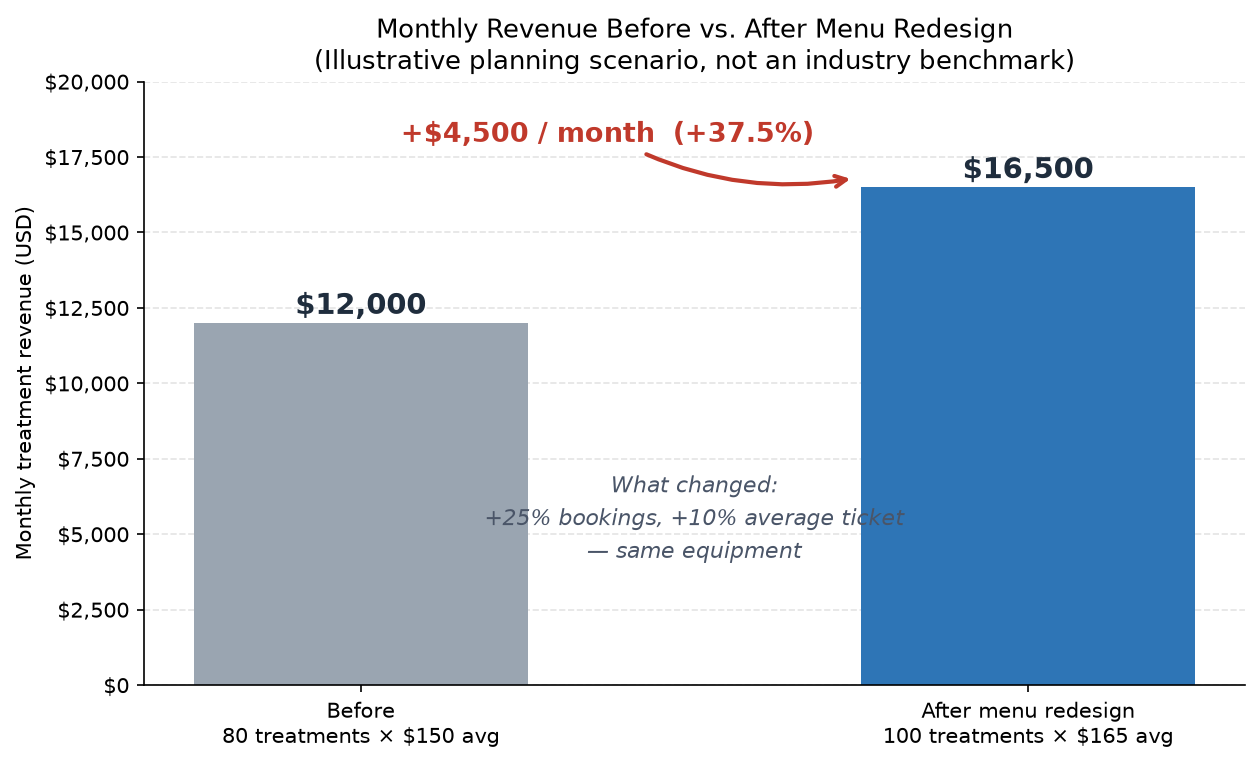
Suppose the clinic performs 80 treatments per month with an average realized treatment revenue of $150.
80 treatments × $150 = $12,000 monthly treatment revenue
Now imagine the clinic improves its menu structure and package sales so that it reaches 100 treatments per month while increasing average realized revenue to $165.
100 treatments × $165 = $16,500 monthly treatment revenue
That is a $4,500 difference in monthly treatment revenue without assuming the clinic needs to double its equipment inventory.
The example shows why menu design matters: growth can come from more bookings, better treatment mix, higher average ticket, stronger utilization, or repeat visits — not only from buying another machine.
FAQ
These are some of the practical questions clinic owners commonly have when planning an aesthetic treatment menu, setting prices, and deciding which equipment to invest in.
What Is an Aesthetic Treatment Menu?
An aesthetic treatment menu is the organized list of services a clinic offers, usually including treatment descriptions, prices, packages, and relevant options. A well-designed menu also helps guide clients toward suitable next steps rather than simply displaying a list of services.
How Many Treatments Should a Clinic Offer?
There is no universal number that works for every clinic. For a new or smaller clinic, a focused menu of roughly 8–12 clearly defined treatments can be easier to market, staff, schedule, and optimize than a large menu, but the right number depends on your market and business model.
What Are the Most Profitable Aesthetic Treatments?
There is no single treatment that is the most profitable for every clinic. Profitability depends on local demand, selling price, treatment time, consumables, staffing, equipment investment, utilization, and repeat potential, so compare these factors using your own clinic's numbers.
How Do I Price Aesthetic Treatments?
Start with the real cost of delivering the treatment, including consumables, labor, equipment allocation, and relevant operating costs. Then consider your local market, positioning, client value, and desired margin rather than simply copying a competitor's price.
Should I Offer Treatment Packages?
Packages can work well when a treatment naturally involves multiple sessions or ongoing maintenance. Calculate the total cost and expected margin before offering a discount, and make sure the package still makes financial sense for the clinic.
How Do I Choose an Aesthetic Machine?
Start with the treatment and customer demand, then compare equipment based on intended applications, performance, training, technical support, consumables, maintenance, total cost of ownership, and applicable regulatory requirements in your market. A machine should solve a real business need rather than simply add another technology to your equipment list.
How Can I Increase Revenue Without New Machines?
Before buying another machine, look at how well your existing equipment and treatment rooms are being utilized. Improving rebooking, packages, treatment positioning, cross-selling, pricing, and revenue per treatment-hour can sometimes create additional revenue from capacity you already have.
How Do I Keep Clients Coming Back for Maintenance?
Give clients a clear follow-up plan that is appropriate for the treatment and their individual needs. Rebooking before the client leaves, explaining maintenance timing, and making the next appointment easy can turn a one-time treatment into a longer client relationship.
Ready to Build a Better Treatment Menu?
Choosing the right treatments is only the first step. The equipment behind them also needs to fit your market, budget, treatment volume, and long-term business goals.
If you're planning to add a new aesthetic treatment or looking for the right equipment for your clinic, talk to the Krysmed team. We can help you compare suitable technologies, understand equipment and consumable costs, and find a solution that makes sense for your treatment menu.
Final Takeaway
A profitable aesthetic treatment menu does not need to be complicated. Start with real client needs, organize your services into Entry, Core, Premium, and Maintenance, price them using real costs, and track what each treatment contributes to your limited room time.
Then let the numbers guide the next move.
The best treatment menu is not the one with the most treatments or the most expensive machines. It is the one where every service has a clear job in the business — and a clear reason for the client to book it.
Our Contact
Ready to Elevate Your Business with Krysmed?
Let’s discuss your needs and find the best solution for your business. Our experts are here to provide personalized recommendations tailored to your business needs.
-
Call For Inquiry
-
Send Us Email
info@krysmed.com
Get A Custom Quote Now!
We value your privacy and guarantee a prompt, professional reply.
 WhatsApp
 info@krysmed.com
 +86 19867944875