

News

September 19, 2026

How to Choose a Diode Laser for a High-Volume Clinic or Premium Aesthetic Spa
Short Answer
For a high-volume clinic or premium aesthetic spa, choosing a diode laser is less about finding the machine with the highest headline power and more about finding a system that can handle repeated daily treatments without creating workflow bottlenecks or excessive downtime risk. The key factors are treatment volume, treatment speed, spot size, cooling, continuous operation, flash lifespan, wavelength flexibility, staff workflow, data management, warranty, downtime risk, cost per treatment and premium positioning. This is where KrySmooth AI Diode Laser is designed to fit: a premium professional platform built around a three-wavelength configuration of 755nm, 808nm and 1064nm, advanced cooling, high flash capacity, treatment-data management and a workflow suited to clinics that expect their laser service to become a significant part of daily business. |
Why High-Volume Clinics Need a Different Diode Laser
A machine that works well for a few appointments per week may not be the right machine for a clinic running a busy hair-removal schedule every day.
As utilization increases, small differences in workflow become much more important. Treatment time, cooling stability, handpiece operation, data handling, maintenance and downtime can all affect how many appointments the clinic can realistically support.
For buyers comparing professional diode laser hair removal machines, the important question is therefore not simply: "What specifications does the machine have?" It is:
"Can this system support the way my clinic actually operates?" |
Start With Treatment Volume, Not Machine Price
The first step is to estimate how much the machine will actually be used.
Low Utilization
A clinic performing a small number of hair-removal appointments each week may prioritize a controlled initial investment and simple operation. In this situation, paying for capabilities that are rarely used may not make commercial sense.
High Utilization
A high-volume clinic has a different calculation because the machine becomes part of the daily operating infrastructure. Reliability, treatment workflow, cooling, handpiece efficiency and service support become more important as appointment volume increases.
Premium Aesthetic Spa
A premium spa may also have a different requirement even when its treatment volume is not extremely high. The equipment may need to support a more premium customer experience, broader service positioning, consistent workflow and a professional visual presentation.
| Clinic Profile | Main Equipment Priority | Typical Buying Question |
| Low-volume salon | Controlled investment | Do I need a premium configuration? |
| Growing clinic | Flexibility + workflow | Can the machine support increasing bookings? |
| High-volume clinic | Throughput + uptime | Can the machine handle repeated daily treatments? |
| Premium aesthetic spa | Technology + client experience | Does the system support premium positioning? |
Treatment Speed Matters More When the Schedule Is Full
Treatment speed is not simply about the number shown beside "Hz."
The actual appointment time depends on spot size, repetition rate, treatment area, operator technique, treatment protocol and the way the machine delivers energy.
Why Speed Affects Revenue Capacity
A machine that can support an efficient workflow may allow the clinic to fit more appointments into the same operating day. The goal is not to maximize speed at any cost; the real objective is an efficient treatment workflow while maintaining appropriate treatment parameters, cooling and operator control.
Look at the Whole System
When comparing diode lasers, ask the supplier about spot size, available frequency, pulse width, energy range and cooling together rather than treating frequency as a standalone performance number. KrySmooth AI is configured with an adjustable 1–10Hz frequency range, giving operators flexibility across different treatment requirements and working conditions.
Spot Size Can Have a Bigger Business Impact Than Expected
Spot size is sometimes treated as a technical specification, but for a high-volume clinic it is also a workflow specification.
Larger Treatment Areas
Larger effective spot coverage can be useful when treating larger body areas because the operator can cover more area with each placement.
Smaller or More Precise Areas
Smaller treatment areas may require more controlled application and different handpiece positioning.
Why KrySmooth AI Uses a 16 × 35mm Spot
KrySmooth AI is configured with a 16 × 35mm treatment spot, giving the operator a substantial treatment area while maintaining a practical handpiece format. The commercial value is not simply "bigger is better." What matters is whether the spot size works efficiently with the clinic's most common treatment areas.
Cooling Is a Business Issue, Not Just a Comfort Feature
For a high-volume clinic, cooling should be evaluated from both the treatment and operational perspective.
Repeated treatments place demands on the machine's thermal-management system. A cooling system that works well for occasional use should also be evaluated for how it performs during a busy working day.
What to Ask About Cooling
When comparing suppliers, ask:
| Cooling Question | Why It Matters |
| What cooling technology is used? | Helps you understand the system architecture |
| How is treatment-head temperature managed? | Relevant to treatment workflow and client comfort |
| What happens during repeated treatments? | Important for high daily utilization |
| How is the cooling system maintained? | Affects long-term operating requirements |
| What happens if the cooling system requires service? | Directly relates to downtime risk |
KrySmooth AI uses a TEC cooling system, with the current configuration specified at approximately −22°C cooling performance at the treatment interface.
For a high-volume clinic, however, the more important question is not simply the lowest temperature number. It is whether the complete cooling system supports the clinic's expected workload and operating workflow.
Can the Diode Laser Handle Continuous Daily Operation?
"Continuous operation" should not be interpreted as literally running a laser without interruption. For a clinic, the more useful question is:
"Can the machine reliably support repeated treatment sessions throughout a normal working day?" |
That requires looking at several components together.
Thermal Management
Laser sources, power supplies and cooling systems all generate operational heat. The overall machine architecture needs to manage that heat during repeated use.
Cooling Recovery
The treatment head and cooling system need to maintain stable operation as treatments continue throughout the day.
Serviceability
High utilization increases the importance of maintenance access, replacement parts and technical support.
Operational Planning
A serious clinic should therefore ask the manufacturer about recommended operating conditions, maintenance intervals and service procedures rather than relying on the phrase "continuous operation" in a sales brochure.
Flash Lifespan Becomes More Important at High Volume
A diode laser's flash or shot capacity matters because high-volume clinics can accumulate a large number of shots over time. A system that performs only a few treatments per week may use its rated capacity very differently from a clinic running dozens of treatment sessions every month.
KrySmooth AI: 50 Million Effective Flashes
KrySmooth AI is specified with 50 million effective flashes, giving it a high rated shot capacity for a machine intended for demanding professional use. But shot capacity should not be viewed in isolation. A better question is:
How does the rated flash lifespan compare with the clinic's expected annual treatment volume? For example, a clinic can estimate: |
This provides a much more useful way to interpret a flash-life specification.
| Planning Factor | What to Calculate |
| Monthly treatments | Expected number of appointments |
| Average shots per treatment | Based on actual treatment workflow |
| Annual shots | Monthly treatments × 12 × shots per treatment |
| Machine shot capacity | Total rated effective flashes |
| Expected utilization period | Shot capacity ÷ estimated annual shots |
The calculation is only an estimate because actual shot usage varies by treatment area and operating parameters.
Multiple Wavelengths: Flexibility for a Broader Client Mix
For a high-volume or premium clinic, wavelength flexibility can help support a wider range of client profiles.
KrySmooth AI uses a three-wavelength configuration: 755nm, 808nm and 1064nm.
The purpose of this configuration is not to claim that every client needs every wavelength. Instead, it gives the clinic more flexibility to select an appropriate wavelength according to client characteristics and professional treatment requirements.
For a detailed technical comparison of these wavelengths, see our guide to 755nm vs 808nm vs 1064nm diode laser configurations.
Why This Matters for Premium Clinics
A premium spa may want to serve a broader customer base without maintaining multiple dedicated hair-removal platforms. A three-wavelength system can provide a more flexible platform while keeping the workflow centered around one machine.
Staff Workflow Can Make or Break Daily Productivity
A professional laser is not operated by specifications alone. The operator interacts with the handpiece, touchscreen, treatment settings, cooling system, client records and treatment workflow throughout the day.
Simple Operation Matters
When the schedule is busy, operators need to move efficiently from one appointment to the next. Controls should be clear enough that trained staff can work confidently without unnecessary steps.
Consistent Workflow Matters Even More
If different staff members use the machine, consistency becomes important. A professional system should support a repeatable workflow in which operators can review client information, record treatment data and manage the machine without creating unnecessary administrative work.
KrySmooth AI and Data-Assisted Workflow
KrySmooth AI includes AI-assisted data tracking for client and treatment-related information. This is intended to support record keeping and clinic workflow rather than replace professional judgment or automatically determine treatment protocols.
Data Management Is More Valuable When the Clinic Gets Busy
Data management becomes much more important as treatment volume increases. When a clinic has only a few laser clients, remembering treatment history may be relatively simple. With a large client base, manually tracking every appointment and treatment detail becomes much more difficult.
What Should the System Help You Track?
| Data Category | Business Value |
| Client information | Improves organization of treatment records |
| Treatment history | Helps staff review previous sessions |
| Body area | Makes records easier to reference |
| Usage data | Helps monitor machine utilization |
| Operator workflow | Supports more consistent day-to-day use |
| Remote support information | Can make technical troubleshooting more efficient |
For a premium clinic, the value of software is therefore not about making the machine look more advanced. The real value is reducing friction in the daily operation of the business.
Warranty Matters More When the Machine Is a Revenue-Generating Asset
A diode laser used heavily is not simply equipment sitting in storage. It is part of the clinic's revenue-generating workflow.
If the machine becomes unavailable, the consequences may include rescheduled appointments, unused staff time and lost treatment capacity.
What Should You Check?
| Warranty Question | Why It Matters |
| How long is the warranty? | Defines the initial equipment protection period |
| What components are covered? | Coverage may vary by component |
| How are technical issues diagnosed? | Important for reducing troubleshooting time |
| Are spare parts available? | Can affect repair time |
| Is remote technical support available? | Useful when supplier and clinic are in different countries |
KrySmooth AI is currently offered with a 2-year warranty, together with remote support capabilities designed to assist international users.
Downtime Risk Should Be Included in the Buying Decision
The cheapest machine on the quotation may not be the cheapest machine to own. This becomes particularly relevant for high-volume clinics. Imagine a clinic normally schedules several hair-removal appointments every day. If the machine is unavailable for several working days, the clinic may lose more than the direct repair cost.
Think About Downtime as a Business Cost
A simple planning formula is:
Downtime Cost = Lost Treatment Contribution + Additional Rescheduling Cost + Repair/Service Cost |
This does not mean every equipment failure creates the same loss. It simply shows why service support deserves a place in the purchasing calculation.
Questions Worth Asking the Manufacturer
Before purchasing, ask:
How quickly can technical support respond? Which spare parts are normally kept available? Can troubleshooting be performed remotely? What happens if a major component requires replacement? |
These questions are especially important for premium clinics where the equipment is expected to support a full treatment schedule.
Cost Per Treatment: Look Beyond the Purchase Price
A premium diode laser should not be evaluated only by its purchase price. The better question is:
"What does each treatment actually cost the clinic after the equipment is installed?" A practical model is: |
Equipment Allocation
Divide the expected equipment investment across the number of treatments you expect to perform during the planning period.
Electricity
Calculate electricity from actual machine input and local electricity rates rather than confusing laser output power with electrical consumption.
Maintenance
Include scheduled maintenance and a reasonable reserve for service-related costs.
Labor
Calculate the staff time required to deliver the service.
Consumables
Include treatment-related supplies, cleaning materials and other recurring items used in your workflow.
For a deeper breakdown of the operating-cost model, see our article on how much it really costs to run a diode laser hair removal machine.
Why Premium Positioning Changes the Buying Decision
A premium aesthetic spa is not always looking for the lowest possible operating cost. The clinic may instead be building a service around technology, treatment experience, operational consistency and brand positioning.
Premium Equipment Should Support a Premium Business Model
The machine itself does not create premium positioning. What matters is whether the equipment supports the experience the clinic is trying to provide through professional presentation, workflow, technology, staff training and consistent service delivery.
Avoid Paying for Features You Cannot Use
Premium does not mean "buy every available specification." A feature is commercially useful only when it supports the clinic's actual customer base, treatment volume or operating model. That is why KrySmooth AI is positioned for established clinics, high-volume businesses and premium aesthetic spas, rather than being presented as the default machine for every salon.
When Does KrySmooth AI Make Sense?
KrySmooth AI is particularly relevant when the clinic has several of the following characteristics:
| Clinic Requirement | Why KrySmooth AI Is Relevant |
| High monthly treatment volume | High flash capacity and workflow-oriented design |
| Need for broader wavelength flexibility | 755nm + 808nm + 1064nm configuration |
| Demanding daily schedule | TEC cooling and professional system architecture |
| Premium service positioning | High-end equipment presentation and multi-function workflow |
| Need for treatment records | AI-assisted client and treatment data management |
| International or multi-site support requirements | Remote technical support capability |
| Long-term equipment planning | 50M effective flashes and 2-year warranty |
The key point is that these features become meaningful when they solve actual operational requirements.
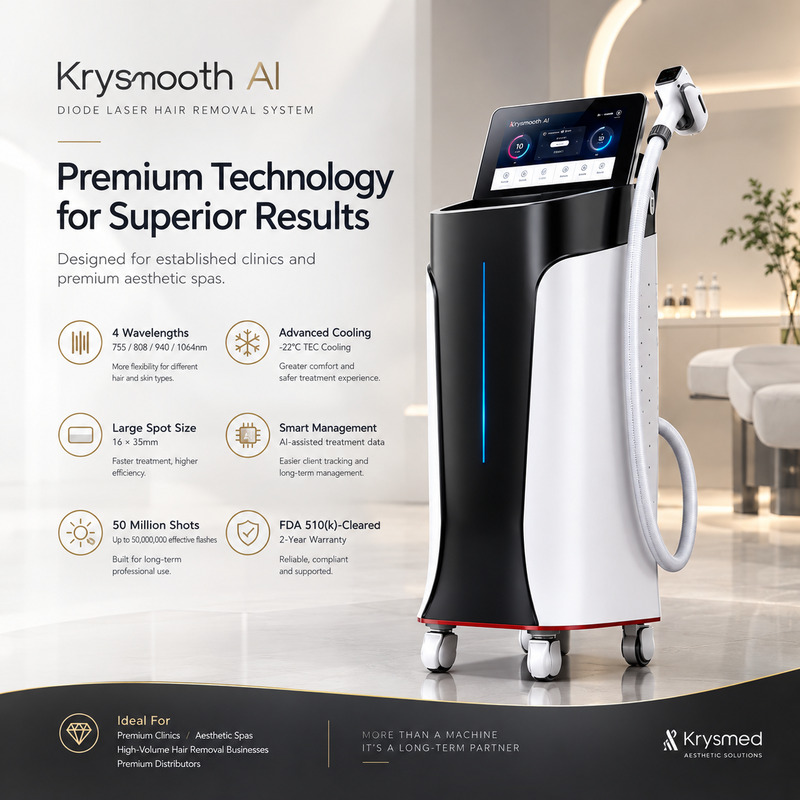
KrySmooth AI Specifications That Matter for High-Volume Use
For buyers evaluating the system, the following specifications are more useful than a generic "high-power diode laser" description.
| Specification | KrySmooth AI | Why It Matters for a Busy Clinic |
| Wavelengths | 755nm / 808nm / 1064nm | Broader treatment configuration flexibility |
| Laser power | 1600W | Part of the system's overall energy-delivery architecture |
| Output power | 3000W | Should be evaluated together with actual operating parameters |
| Energy | 1–120 J/cm² | Provides adjustable energy range |
| Frequency | 1–10Hz | Supports different workflow requirements |
| Pulse width | 1–370ms | Provides parameter flexibility |
| Laser bars | 12 | Part of the laser-source architecture |
| Spot size | 16 × 35mm | Relevant to treatment coverage and workflow |
| Cooling | TEC, approximately −22°C | Supports treatment-head cooling |
| Effective flashes | 50 million | Supports long-term high-volume planning |
| Warranty | 2 years | Provides defined initial coverage period |
| Data management | AI-assisted tracking | Supports client and treatment record management |
| Remote support | Wi-Fi remote support | Useful for international technical assistance |
| Display | Foldable LCD touchscreen | Supports daily operator workflow |
| Regulatory documentation | FDA 510(k)-cleared configuration | Relevant documentation for applicable U.S. projects |
Specifications refer to the current product configuration and should be confirmed in the final quotation. Treatment parameters, client suitability and treatment protocols should be determined by appropriately trained professionals according to the specific device and applicable local requirements.
What High-Volume Clinics Should Ask Before Ordering
A serious equipment evaluation should go beyond "How much is the machine?" Use this checklist before requesting a final quotation.
| Area | Question to Ask |
| Volume | Can this configuration support our expected daily treatment schedule? |
| Speed | What determines actual treatment time in our main treatment areas? |
| Spot size | Is the treatment spot suitable for our highest-volume areas? |
| Cooling | How does cooling perform during repeated treatments? |
| Wavelengths | Does the configuration match our client mix? |
| Flash lifespan | How does the rated flash capacity compare with our expected annual usage? |
| Workflow | Can different trained operators use the system consistently? |
| Data | How are client and treatment records managed? |
| Warranty | What is included in the warranty? |
| Downtime | How is technical support handled when the machine is unavailable? |
| Operating cost | What are the expected maintenance and operating costs? |
| Business positioning | Does the machine fit the clinic's intended premium service positioning? |
A Practical Decision Framework for Premium Clinics
A useful way to compare systems is to score them against your actual operating requirements, rather than creating a generic ranking.
Step 1: Estimate Monthly Treatment Volume
Start with the number of appointments you realistically expect rather than an optimistic maximum.
Step 2: Identify Your Main Treatment Areas
A machine used mainly for legs and back will have different workflow requirements from one used mainly for smaller areas.
Step 3: Check Your Client Mix
Consider the range of skin tones and hair characteristics represented in your market.
Step 4: Calculate Cost Per Treatment
Include equipment, electricity, labor, maintenance and consumables.
Step 5: Estimate the Cost of Downtime
Think about what happens financially if the machine is unavailable for several days.
Step 6: Decide Whether Premium Features Have a Commercial Purpose
Ask whether additional wavelengths, cooling, data management, flash capacity and workflow improvements solve real problems for your clinic.
Why KrySmooth AI Is Built for the Premium Segment
KrySmooth AI is not positioned around one specification alone.
Its value comes from bringing several operational elements together: three wavelength options, adjustable operating parameters, 16 × 35mm spot size, TEC cooling, 50 million effective flashes, AI-assisted data management, remote support and a 2-year warranty.
For a premium spa or high-volume clinic, that combination can be more relevant than simply comparing machine purchase prices. The goal is to build a laser platform around the way the clinic operates—not to add specifications simply for the sake of a longer product sheet.
Final Takeaway
Choosing a diode laser for a high-volume clinic or premium aesthetic spa requires looking at the machine as a business operating system, not just a laser source.
Treatment volume affects the value of speed and flash capacity. Spot size affects workflow. Cooling affects repeated operation. Multiple wavelengths affect client flexibility. Data management affects staff efficiency. Warranty and service support affect downtime risk. And all of these ultimately influence the real cost per treatment.
For clinics that expect high utilization or want to build a premium hair-removal service, KrySmooth AI provides a three-wavelength 755nm + 808nm + 1064nm platform with high flash capacity, TEC cooling, treatment-data management and a 2-year warranty.
The right question is not whether a premium diode laser has more specifications. It is whether those specifications solve problems your clinic will actually face. |
FAQ
What should a high-volume clinic look for in a diode laser?
Focus on treatment workflow, cooling, spot size, operating range, flash capacity, wavelength flexibility, data management, warranty, technical support and expected cost per treatment. Purchase price should be considered together with these operational factors.
Is treatment speed important for a busy aesthetic clinic?
Yes, but actual treatment speed depends on more than frequency. Spot size, treatment area, operating parameters, operator workflow and cooling all contribute to the time required for a treatment.
Why does spot size matter for high-volume hair removal?
Spot size affects how efficiently the operator can cover different treatment areas. It is particularly relevant when the clinic performs many large-area treatments.
How many flashes should a professional diode laser have?
There is no universal number. The useful figure depends on expected treatment volume and how many shots are used per treatment. KrySmooth AI is specified with 50 million effective flashes.
Is a three-wavelength diode laser better for a premium clinic?
A three-wavelength configuration provides more flexibility than a single-wavelength system, but whether that flexibility is commercially useful depends on the clinic's customer mix and service model. KrySmooth AI uses 755nm, 808nm and 1064nm.
What cooling system should a high-volume diode laser have?
The important question is not simply which cooling technology sounds most advanced. Buyers should evaluate cooling performance, thermal management during repeated treatments, maintenance requirements and technical support together.
Why is downtime risk important when buying a diode laser?
For a high-volume clinic, the machine is directly connected to treatment capacity. Equipment downtime can result in rescheduled appointments and lost operating capacity, so warranty and service support should be part of the purchasing decision.
Does AI mean the laser automatically chooses treatment parameters?
No. In KrySmooth AI, the AI-related functionality is focused on data and workflow support. Treatment parameters should still be selected and used by appropriately trained professionals according to the device configuration and applicable requirements.
Is KrySmooth AI suitable for a premium aesthetic spa?
KrySmooth AI is positioned as a premium diode laser platform for established clinics, high-volume businesses and premium aesthetic spas that value wavelength flexibility, cooling, workflow, data management, high flash capacity and long-term equipment planning.
Ready to Build a High-Volume Hair Removal Service?
Let's Talk About Your KrySmooth AI Configuration
Tell Krysmed about your expected treatment volume, main treatment areas, target client profile and market. We can discuss the KrySmooth AI configuration, technical specifications, training, warranty and support based on the way your clinic plans to operate.
Contact Krysmed to discuss KrySmooth AI and request a quotation.
| Contact Krysmed → |
| View KrySmooth AI Specifications → |
Our Contact
Ready to Elevate Your Business with Krysmed?
Let’s discuss your needs and find the best solution for your business. Our experts are here to provide personalized recommendations tailored to your business needs.
-
Call For Inquiry
-
Send Us Email
info@krysmed.com
Get A Custom Quote Now!
We value your privacy and guarantee a prompt, professional reply.
 WhatsApp
 info@krysmed.com
 +86 19867944875